
“This post contains affiliate links. If you click and buy, we may earn a small commission at no extra cost to you. See our Affiliate Disclaimer for details.”
Bathroom shelves can add useful storage without taking up much floor space, making them especially valuable in small or busy bathrooms. But choosing the right shelves involves more than finding a design that looks good.
The size of the wall, moisture levels, shelf material, mounting method, and items you plan to store all affect which option will work best.
A shelf that is too deep can make a small bathroom feel cramped, while poorly positioned shelving can interfere with mirrors, doors, toilets, or everyday movement.
This guide explains how to choose, position, and style bathroom shelves so they provide practical storage while complementing the rest of the room.
Table of Contents
How to Choose Bathroom Shelves
Before deciding on a style, think about what you actually need the shelves to do.
Are you trying to store everyday toiletries? Display towels? Organize items above the toilet? Add storage inside the shower? Or simply fill an empty wall with a few decorative objects?
Start by considering:
- Available wall space
- What you need to store
- Shelf depth and width
- Bathroom moisture levels
- Wall construction
- Weight requirements
- Existing bathroom fixtures
- Overall decorating style
Taking a few measurements before choosing shelves can prevent many common installation and layout problems.
Types of Bathroom Shelves
Different shelf designs work better in different parts of a bathroom.
Floating Bathroom Shelves
Floating shelves attach to the wall with hardware that is largely concealed once installed.
Their simple appearance makes them suitable for modern, Scandinavian, minimalist, and contemporary bathrooms.
They can be useful for:
- Folded hand towels
- Small baskets
- Toiletries
- Decorative objects
- Plants suited to bathroom conditions
Floating shelves are particularly useful when you want storage without adding a freestanding cabinet.
Always follow the manufacturer’s mounting instructions and weight limits.
Wall-Mounted Shelves With Brackets
Bracket shelves use visible supports underneath the shelf.
Depending on the design, brackets can become part of the room’s style rather than something that needs to be hidden.
For example, wood shelves with dark metal brackets can complement industrial or rustic bathrooms, while simpler brackets can work in traditional or transitional spaces.
Visible brackets can also make it easier to understand how the shelf is supported.
Corner Bathroom Shelves
Corners are frequently underused, especially in compact bathrooms.
Corner shelves can provide storage without occupying the center of a wall.
They may work well:
- Near a vanity
- In an empty corner
- Beside a bathtub
- Inside a shower when designed for wet areas
Measure carefully because corner shelf dimensions can be difficult to judge from product photographs.
Freestanding Bathroom Shelves
Not every shelf needs to be attached to a wall.
Freestanding shelving units can be useful for renters or anyone who prefers not to drill into walls.
Narrow units can fit beside:
- A vanity
- A toilet
- A bathtub
- An unused bathroom corner
The disadvantage is that they consume floor space, so wall-mounted storage may be more efficient in very small bathrooms.
Ladder Shelves
Ladder-style shelving provides several levels of storage while maintaining a relatively open appearance.
It can work well for towels, baskets, and decorative items.
However, check the unit’s footprint and stability before using one in a narrow bathroom.
Best Materials for Bathroom Shelves
Bathrooms create different conditions from bedrooms and living rooms.
Humidity, condensation, and direct water exposure can affect materials over time, so shelf location matters.
Wood
Wood shelves can add warmth and texture to a bathroom.
However, not every wood product is suitable for humid conditions.
Look at the manufacturer’s recommendations and finish specifications. Shelves located near a shower or bathtub may experience considerably more moisture than shelves in a well-ventilated area farther from water.
Glass
Glass shelves can create a visually light appearance and work particularly well around vanities.
Because you can see through them, they don’t create the same visual block as thick opaque shelving.
They can also be relatively easy to wipe clean.
If choosing glass shelving, use products designed for their intended application and follow the manufacturer’s installation and load instructions.
Metal
Metal shelving can work well in modern and industrial bathrooms.
For bathroom use, pay attention to the manufacturer’s information regarding moisture and corrosion resistance, particularly when shelves will be located close to a shower or bathtub.
Engineered Wood
Engineered wood shelves are widely available and can be affordable.
However, moisture resistance varies considerably.
Check the manufacturer’s specifications rather than assuming that every engineered-wood shelf is suitable for a humid bathroom.
Where to Put Bathroom Shelves
Good placement should make storage easier without interfering with how you use the room.
Above the Toilet
The wall above a toilet is often unused, making it a popular location for bathroom shelves.
This area can hold:
- Extra toilet paper
- Small baskets
- Hand towels
- Decorative objects
- Backup toiletries
Avoid making shelves unnecessarily deep in a tight bathroom.
You should also position them so they don’t make the toilet area uncomfortable to use.
Above the Vanity
Shelving near a vanity can provide convenient storage for items you use regularly.
However, consider the relationship between the shelf, mirror, lighting, and faucet area.
In many bathrooms, a mirror should remain the main feature above the vanity. Shelves may work better beside it rather than directly above it.
Beside the Mirror
A narrow shelf or small group of shelves beside a bathroom mirror can make use of vertical wall space.
This arrangement can be particularly useful when the vanity has limited countertop storage.
Above a Bathtub
Shelves above or near a bathtub can hold decorative items or bath products, but this location requires additional attention to moisture and installation.
Avoid placing objects where they could easily fall into the tub or create a hazard.
Inside the Shower
Shower shelving has different requirements from general bathroom shelving because it is regularly exposed to water.
Use products specifically designed for shower or wet-area use.
Common options include:
- Built-in niches
- Corner shelves
- Shower caddies
- Wall-mounted shower shelves
Follow the product manufacturer’s installation requirements, particularly when drilling into tiled or waterproofed surfaces.
How High Should Bathroom Shelves Be?
There isn’t one correct height for every bathroom shelf.
The right position depends on:
- What the shelf will hold
- Who needs to reach it
- Furniture or fixtures underneath
- Ceiling height
- Shelf depth
- Number of shelves
Everyday products should generally be easy to reach without uncomfortable stretching.
Decorative or backup-storage shelves can be positioned higher because they aren’t accessed as frequently.
Before drilling into the wall, temporarily mark the proposed shelf position with painter’s tape. This makes it easier to judge the proportions from different parts of the room.
How Deep Should Bathroom Shelves Be?
Shelf depth should correspond to what you plan to store.
Small toiletries and decorative objects require much less depth than large baskets or folded towels.
In a compact bathroom, unnecessarily deep shelves can protrude into walking areas and make the room feel tighter.
Measure the objects you plan to store before choosing the shelf.
Also consider whether the shelf will be positioned above a toilet, beside a doorway, or near another area where people regularly move.
Bathroom Shelves for Small Bathrooms
In a small bathroom, the goal isn’t simply to add more storage.
It’s to add storage without making the room feel more crowded.
Vertical storage is particularly useful because it takes advantage of wall space.
Consider:
- Floating shelves
- Corner shelves
- Narrow wall shelves
- Storage above the toilet
- Shelves beside the mirror
- Recessed niches
- Tall, narrow freestanding units
Avoid filling every empty wall.
A small bathroom can actually feel more cluttered when too many shelves and storage systems are added.
Choose the areas that provide the most useful storage and preserve some visual breathing room.
Open Shelves vs. Closed Bathroom Storage
Open shelving and closed cabinets serve different purposes.
Open Shelving
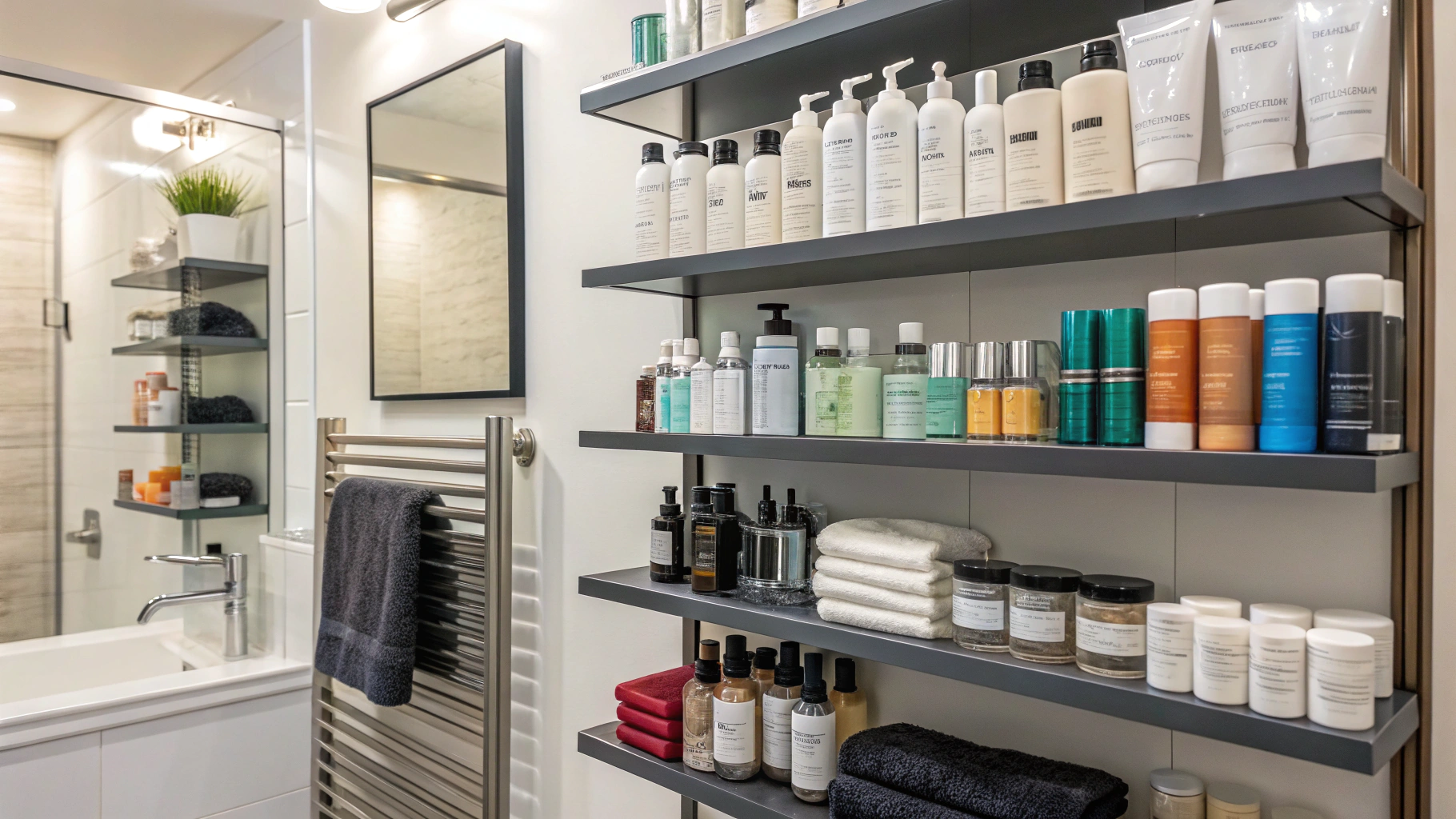
Open shelves make items easy to access and can help a small room feel less visually heavy than a large cabinet.
They’re useful for attractive or frequently used items such as:
- Folded towels
- Matching containers
- Small baskets
- Decorative objects
The disadvantage is that everything remains visible.
Closed Storage
Closed cabinets hide visual clutter and are often better for items you don’t want on display.
These might include:
- Cleaning products
- Backup toiletries
- Personal-care items
- Large packages
Many bathrooms work best with a combination of both.
Use shelves for attractive and frequently used objects while keeping less decorative necessities behind doors or inside drawers.
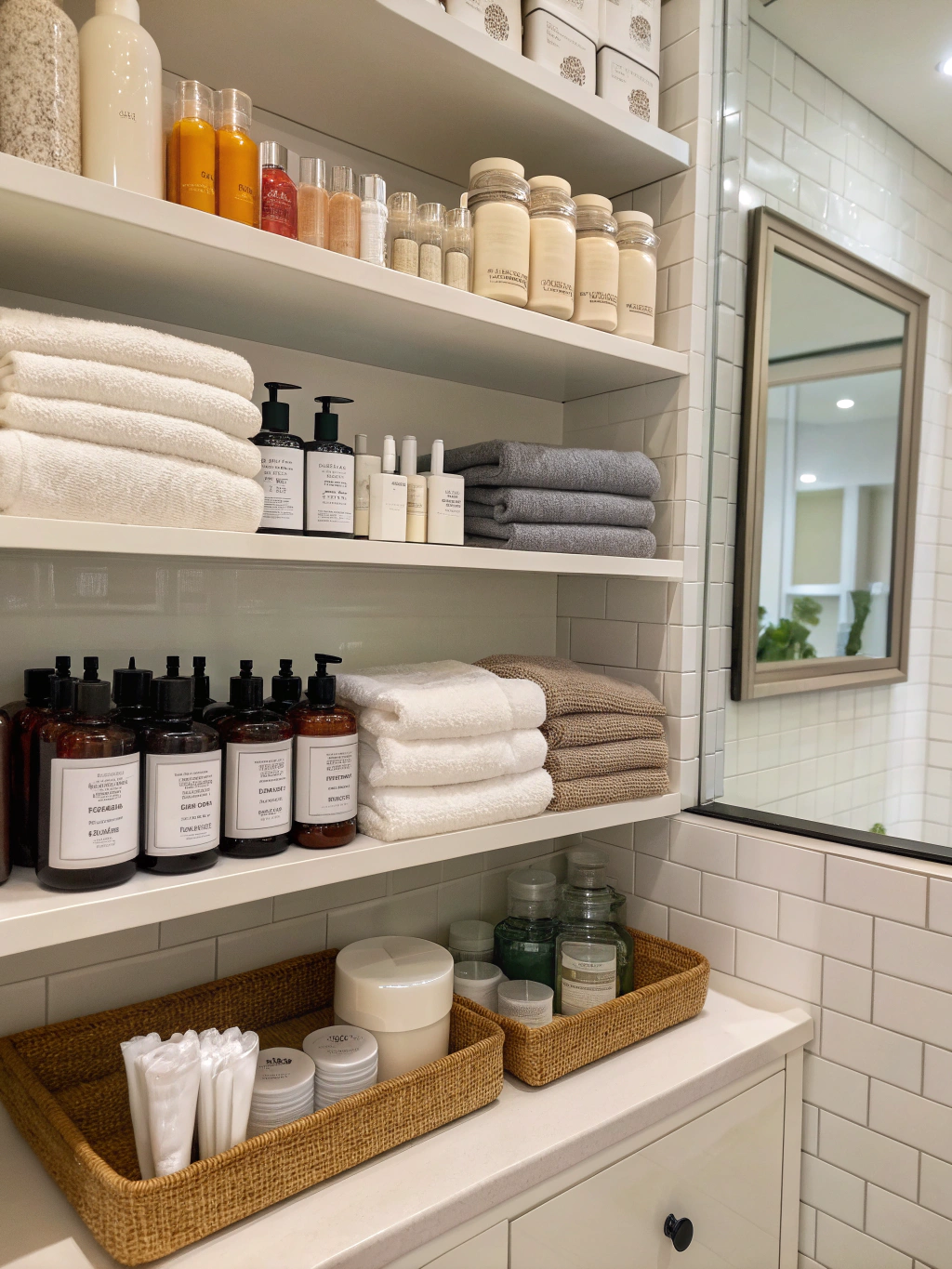
How to Organize Bathroom Shelves
A shelf shouldn’t become another place to pile random objects.
Group similar items together.
For example:
Shelf 1: Everyday toiletries
Shelf 2: Towels
Shelf 3: Backup supplies
Small containers and baskets can help organize loose items.
You can also use trays to create defined zones for frequently used products.
The goal is to make it obvious where things belong so the shelves remain easier to maintain.
How to Style Bathroom Shelves
Bathroom shelves need to be functional, but they don’t have to look purely utilitarian.
Start with the objects you genuinely need to store, then add decorative elements only if space allows.
Use Different Heights
Placing every object at the same height can make a shelf look flat.
Try combining taller and shorter objects, such as a container beside folded towels.
Leave Some Empty Space
You don’t need to fill every inch.
Empty space between groups of objects makes shelves look calmer and allows individual items to stand out.
Use Baskets Carefully
Small baskets can conceal miscellaneous items and create a more organized appearance.
But don’t add baskets simply for decoration. They should serve a practical purpose.
Repeat Materials
Repeating one or two materials can make several shelves feel connected.
For example, you might repeat:
- Wood
- Glass
- Ceramic
- Metal
- Woven textures
This doesn’t mean everything needs to match perfectly.
Limit Decorative Clutter
A bathroom is a functional space.
If decorations make it difficult to reach towels or toiletries, simplify the arrangement.
Bathroom Shelves Above the Toilet
Because this is such a common location, it deserves special consideration.
First, measure the available wall width.
Then think about shelf depth.
A shelf that projects too far can make the area uncomfortable, while one that’s too shallow may not hold the items you intended to store.
For a simple arrangement, you could use two or three shelves with a combination of:
- Extra towels
- Toilet paper
- A small basket
- One decorative item
Keep frequently needed objects on the easiest-to-reach shelf.
Less frequently used items can go higher.
Bathroom Shelves Near a Vanity
Vanity storage needs to remain convenient.
Shelves can hold frequently used products, but avoid placing too many items around the sink.
An overcrowded vanity area can quickly make the entire bathroom look messy.
If possible, separate items into three groups:
Daily essentials — keep accessible.
Occasional items — place on a higher shelf or inside storage.
Backup products — store in a cabinet, basket, or another less prominent location.
This keeps the most visible area of the bathroom easier to maintain.
Bathroom Shelf Ideas for Different Styles
Modern Bathrooms
Consider:
- Simple floating shelves
- Clean lines
- Glass
- Metal
- Neutral finishes
Scandinavian Bathrooms
Look for:
- Light wood
- White finishes
- Simple forms
- Practical storage
- Minimal decoration
Japandi Bathrooms
Consider:
- Natural materials
- Warm neutral colors
- Simple silhouettes
- Limited decorative objects
- Visually calm arrangements
Rustic Bathrooms
Wood shelves with visible texture and simple brackets can complement rustic spaces.
Make sure the material and finish are appropriate for bathroom conditions.
Traditional Bathrooms
Classic brackets, painted shelves, and carefully arranged accessories can work well with traditional vanities and fixtures.
Common Bathroom Shelving Mistakes
Installing Shelves Without Measuring
Don’t rely on photographs or estimates.
Measure the wall, surrounding fixtures, and items you plan to store.
Making Shelves Too Deep
Deep shelves aren’t automatically more useful.
In a narrow bathroom, they can interfere with movement and make the space feel crowded.
Ignoring Moisture
A shelf that works perfectly in a bedroom may not be suitable near a shower.
Always consider the manufacturer’s recommendations for the material and intended environment.
Overloading the Shelves
Follow the manufacturer’s stated weight limits and installation requirements.
The shelf itself may be strong while the mounting method or wall structure becomes the limiting factor.
Filling Every Shelf
More objects don’t necessarily create a better display.
Leave enough open space to keep the arrangement practical and visually balanced.
Putting Everything on Display
Not every bathroom product needs to be visible.
Use drawers, cabinets, and baskets for less attractive necessities.
Bathroom Shelf Installation Considerations
Before installing wall-mounted shelving, determine what type of wall you’re working with.
Mounting requirements can differ depending on whether you’re dealing with drywall, masonry, tile, or another surface.
The appropriate hardware also depends on the shelf and expected load.
Follow the shelf manufacturer’s installation instructions.
If installation requires drilling into tile, plumbing-sensitive areas, electrical areas, or waterproofed shower surfaces and you’re uncertain about what’s behind the wall, consider getting professional assistance rather than guessing.
How to Keep Bathroom Shelves Looking Organized
Bathroom shelves are easier to maintain when everything has a purpose.
Try periodically removing:
- Empty containers
- Expired products
- Products you no longer use
- Excess packaging
- Unnecessary decorative objects
Then wipe down the shelves according to the material’s care instructions.
A simple arrangement is generally easier to maintain than a densely decorated one.
Bathroom Shelves Buying Checklist
Before choosing bathroom shelves, check:
- Available wall width
- Shelf width
- Shelf depth
- Shelf thickness
- Intended storage
- Manufacturer’s weight limit
- Mounting method
- Wall type
- Moisture exposure
- Material
- Finish
- Distance from nearby fixtures
- Accessibility
- Cleaning requirements
A few minutes spent measuring and planning can save you from installing shelves that don’t work well in the space.
Frequently Asked Questions About Bathroom Shelves
What type of shelves are best for a bathroom?
The best type depends on where they’ll be installed and what they’ll hold. Floating shelves work well for general wall storage, while wet areas require shelving designed specifically for moisture and direct water exposure.
Where should bathroom shelves be placed?
Common locations include above the toilet, beside a vanity mirror, on an unused wall, in a corner, or near a bathtub. Placement should preserve comfortable movement and access to fixtures.
Can you put wood shelves in a bathroom?
Wood can be used in bathrooms, but suitability depends on the type of wood, finish, ventilation, and level of moisture exposure. Check the manufacturer’s recommendations before installing wood shelving in humid or wet locations.
Are floating shelves good for small bathrooms?
They can be. Floating shelves use wall space without adding a large piece of floor-standing furniture, which can make them useful in compact bathrooms.
How many shelves should you put above a toilet?
There isn’t a required number. Two or three shelves may work in many layouts, but the appropriate number depends on wall height, shelf spacing, storage needs, and the visual proportions of the bathroom.
Should bathroom shelves match the vanity?
Not necessarily. Shelves can complement the vanity through similar colors, materials, hardware, or undertones without matching it exactly.
How do you make bathroom shelves look less cluttered?
Group similar items, use containers for small objects, limit unnecessary decorations, and leave some open space. Keep less attractive products inside cabinets or baskets when possible.
Final Thoughts
Well-planned bathroom shelves can provide useful storage while making the room feel more organized and intentional.
Start by deciding what you actually need to store. Then measure the available wall space and choose a shelf depth, material, and mounting method appropriate for the location.
In smaller bathrooms, prioritize vertical storage without covering every available wall. In larger bathrooms, shelves can combine practical storage with carefully chosen decorative elements.
Most importantly, choose shelves for the way you actually use your bathroom. Good bathroom storage should make everyday items easier to access without adding unnecessary clutter.