
“This post contains affiliate links. If you click and buy, we may earn a small commission at no extra cost to you. See our Affiliate Disclaimer for details.”
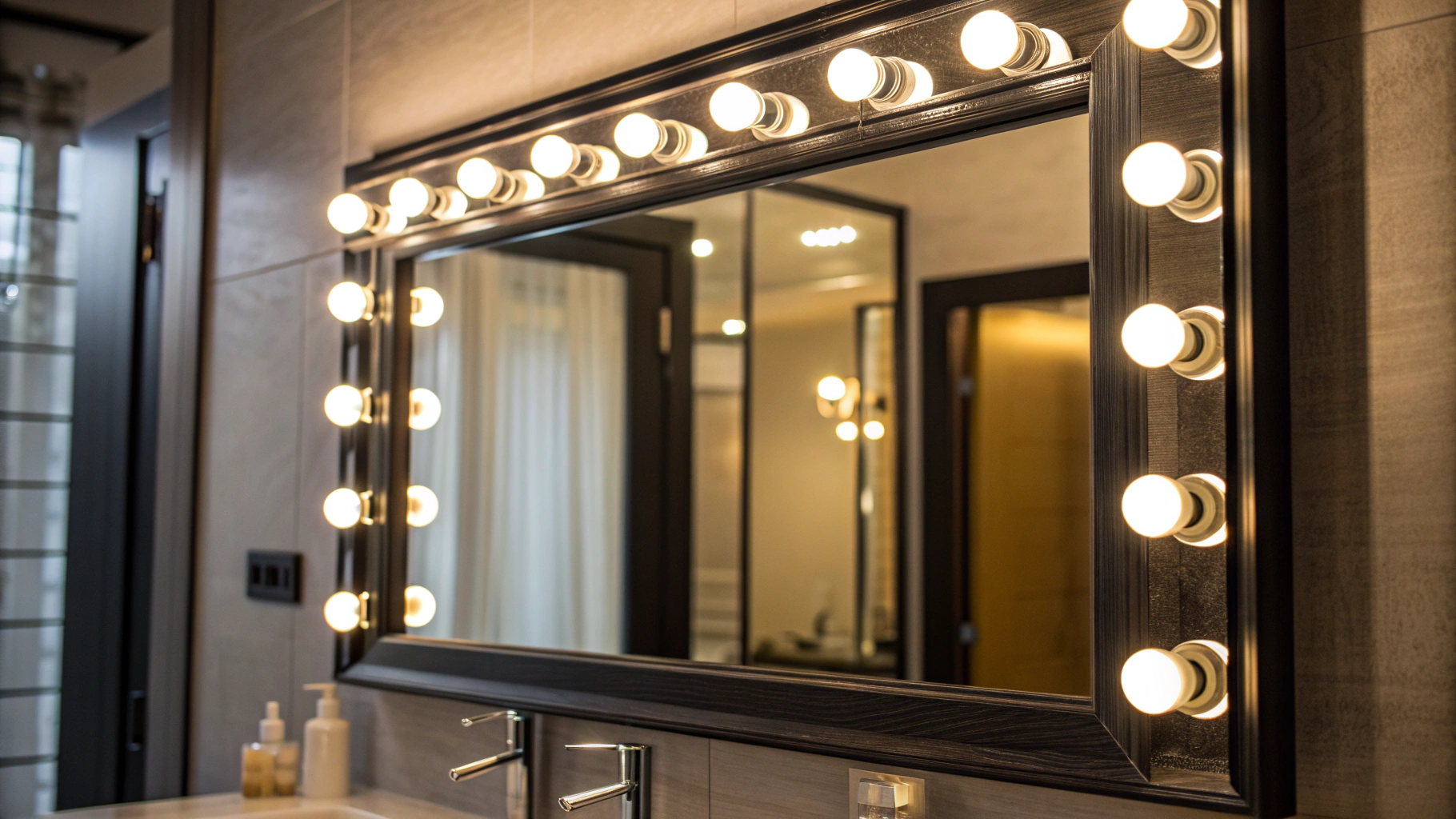
A bathroom mirror with lights can combine two important functions in one fixture: a practical mirror and additional lighting around the vanity. But choosing the right one involves much more than finding a design that looks attractive.
Mirror width, vanity size, mounting height, light direction, color temperature, electrical requirements, and bathroom conditions all affect how well an illuminated mirror works in everyday use.
A mirror that’s too large can overwhelm a small vanity, while poor lighting can create shadows exactly where you don’t want them.
This guide explains what to consider before choosing a lighted bathroom mirror, from sizing and placement to lighting features and installation.
Table of Contents
What Is a Bathroom Mirror With Lights?
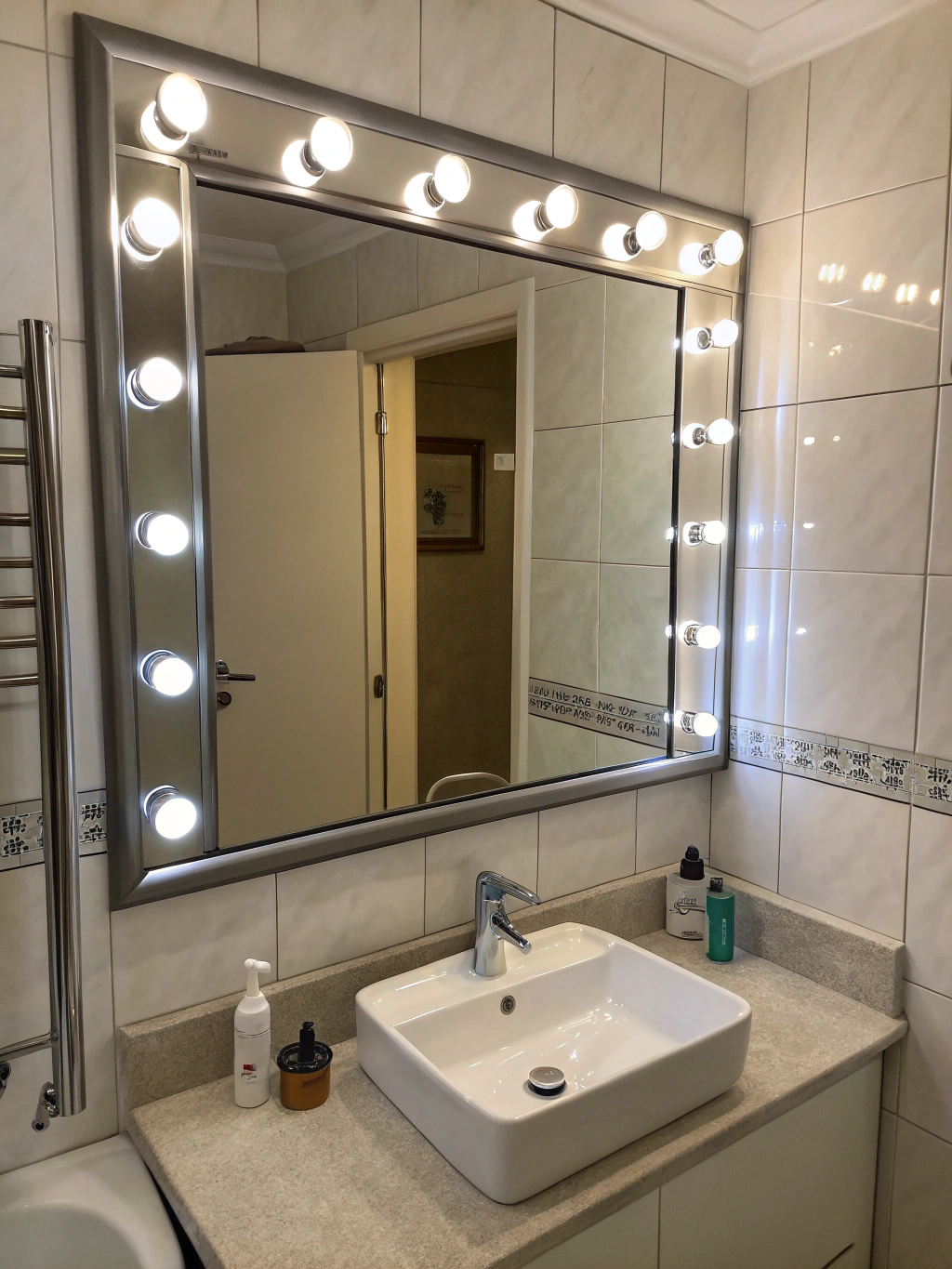
A bathroom mirror with lights is a mirror that incorporates lighting into or around its design.
Instead of relying entirely on separate vanity lights, the mirror itself provides additional illumination.
Depending on the design, the light may appear:
- Around the front edge of the mirror
- Behind the mirror
- Along specific sections of the mirror
- Through illuminated areas built into the glass
You’ll commonly see these products described as LED bathroom mirrors, lighted vanity mirrors, or illuminated bathroom mirrors.
Although these terms are often used interchangeably, the actual lighting design can differ considerably between models.
Why Choose a Lighted Bathroom Mirror?
An illuminated mirror can be useful when you want to combine a clean appearance with practical vanity lighting.
Potential advantages include:
- Additional light around the mirror
- A streamlined vanity area
- Less need for decorative light fixtures around the mirror
- Useful illumination for grooming
- Contemporary appearance
- Features such as dimming or adjustable color temperature on some models
However, an illuminated mirror doesn’t automatically solve every bathroom-lighting problem.
The room may still require general ceiling lighting or other fixtures depending on its size and layout.
How to Choose the Right Mirror Size
Start with your vanity.
Rather than choosing the largest mirror that fits on the wall, think about how its proportions relate to the vanity below it.
Measure:
- Vanity width
- Available wall width
- Distance to nearby walls
- Distance to cabinets
- Ceiling height
- Faucet position
- Existing electrical fixtures
A mirror generally looks more intentional when it relates visually to the vanity rather than appearing disconnected from it.
Should a Bathroom Mirror Be Wider Than the Vanity?
It doesn’t necessarily need to be.
Many bathroom layouts look balanced when the mirror is approximately the same width as the vanity or somewhat narrower.
However, there isn’t one universal ratio that works in every bathroom.
A large wall-to-wall mirror can also work when it is intentionally incorporated into the design.
Consider the complete composition:
Vanity + mirror + lighting + surrounding wall space
rather than judging the mirror independently.
Mirror Size for a Single Vanity
For a single-sink vanity, you can either center one mirror over the vanity or align it primarily with the sink area, depending on the layout.
Before ordering, mark the proposed dimensions on the wall using painter’s tape.
Stand back and view the outline from the doorway.
This simple step can reveal whether a mirror that looked appropriately sized online will actually feel too large or too small in your bathroom.
Mirror Size for a Double Vanity
A double vanity gives you two main approaches.
You can use:
One large illuminated mirror
or
Two individual lighted mirrors
One large mirror can create a continuous visual surface and make the vanity feel unified.
Two separate mirrors can give each sink its own defined area and create more wall space between the mirrors.
Neither approach is inherently better. The right choice depends on vanity dimensions, sink placement, wall space, and the overall style of the bathroom.
How High Should a Bathroom Mirror With Lights Be?
There isn’t one perfect installation height because people, vanities, sinks, and mirrors all vary in size.
The important consideration is whether the mirror provides a comfortable view for the people who regularly use it.
Before installation, consider:
- User height
- Mirror height
- Vanity height
- Faucet height
- Backsplash height
- Ceiling height
- Existing electrical connections
Avoid positioning the mirror based only on a generic measurement.
The mirror should work with the actual users and bathroom layout.
Front-Lit vs. Backlit Bathroom Mirrors
This is one of the most important distinctions when comparing illuminated mirrors.
Front-Lit Mirrors
Front-lit mirrors direct light outward toward the user.
The illuminated section may appear around the mirror’s perimeter or as strips incorporated into the reflective surface.
This type of lighting can be particularly useful when facial illumination is a priority.
Backlit Mirrors
Backlit mirrors project light toward the wall behind the mirror.
This creates a glow around the mirror’s edges and can make it appear to float away from the wall.
Backlighting can provide attractive ambient illumination, but its effect isn’t identical to light directed toward your face.
Mirrors With Both
Some models combine front lighting and backlighting.
This can provide stronger task illumination while also creating a softer glow around the mirror.
If you’re comparing these models, check whether the front and back lighting can be controlled independently.
Understanding Bathroom Mirror Color Temperature
Some illuminated bathroom mirrors allow you to change the apparent warmth or coolness of the light.
This is generally expressed as color temperature, measured in Kelvin (K).
Lower color temperatures appear warmer, while higher temperatures appear cooler.
For example:
Warm light creates a softer, more yellow appearance.
Neutral light sits between warm and cool.
Cooler light appears whiter or more blue-toned.
Which one is best depends partly on how you use the bathroom and the appearance you prefer.
A mirror with adjustable color temperature gives you more flexibility than one fixed lighting mode.
Brightness and Dimming
Brightness is another feature worth considering.
Extremely bright light isn’t automatically better.
A bathroom used early in the morning and late at night may benefit from adjustable brightness.
A dimmable mirror lets you reduce the light when full brightness isn’t necessary.
When comparing models, check whether:
- Brightness is adjustable
- Settings are remembered after the mirror is switched off
- Brightness and color temperature have separate controls
- The mirror can integrate with your intended wall-switch setup
These features vary between products.
Is an Anti-Fog Mirror Worth It?
Some lighted bathroom mirrors include a built-in demister or anti-fog function.
The feature is designed to warm a section of the mirror so condensation is less likely to obscure the reflective surface after a hot shower.
This can be convenient in bathrooms that frequently become steamy.
However, check the product specifications carefully.
The anti-fog area may not cover the entire mirror, and operation varies between models.
Good bathroom ventilation remains important regardless of whether the mirror includes a demister.
Touch Controls
Many modern lighted mirrors use touch-sensitive controls directly on the mirror.
These may control:
- Power
- Brightness
- Color temperature
- Anti-fog function
Touch controls create a clean appearance, but think about how you want to use the mirror every day.
If you prefer controlling bathroom lighting from a wall switch, verify that the mirror supports your intended setup before purchasing.
Memory Functions
Some mirrors remember the previous brightness or color-temperature setting.
This can be useful if you prefer one particular configuration and don’t want to adjust the mirror every time it’s turned on.
Don’t assume every illuminated mirror includes this function.
Check the manufacturer’s specifications.
Plug-In vs. Hardwired Lighted Mirrors
Installation requirements are particularly important for illuminated mirrors because they require electricity.
Plug-In Mirrors
Some mirrors use a conventional power cord.
This can simplify installation when a suitable outlet is available, although the visible cord may affect the appearance.
Hardwired Mirrors
Hardwired models connect directly to the electrical system.
This can create a cleaner finished appearance because there isn’t a visible power cord.
However, electrical work should comply with applicable local requirements and the manufacturer’s instructions.
If you’re uncertain about electrical installation in a bathroom, use a qualified professional rather than attempting unfamiliar electrical work yourself.
Bathroom Electrical Safety Matters
Bathrooms require additional consideration because electricity and water are present in the same environment.
Don’t choose or install an illuminated mirror based only on appearance.
Check:
- Manufacturer installation instructions
- Intended bathroom use
- Electrical specifications
- Required clearances
- Applicable local electrical requirements
- Installation location
Products and electrical rules can vary by location.
For hardwired installation, professional installation may be appropriate.
Where Should a Lighted Mirror Be Positioned?
Most illuminated bathroom mirrors are installed above a vanity, but precise positioning matters.
The mirror should relate visually to the:
- Sink
- Faucet
- Vanity
- Countertop
- Lighting
- Surrounding cabinetry
For a single vanity, centering the mirror around the primary sink area often creates a balanced appearance.
For a double vanity, consider whether one large mirror or two individual mirrors better matches the sink positions.
Bathroom Mirror With Lights for Small Bathrooms
An illuminated mirror can be particularly useful in a compact bathroom because it combines lighting and reflection without necessarily requiring additional fixtures beside the mirror.
For a small bathroom, consider:
- A simple frameless design
- Proportions appropriate for the vanity
- Adjustable brightness
- Front lighting
- A shallow profile
- Minimal visual bulk
A large mirror can also reflect more of the room and distribute light visually, but don’t automatically choose the largest size available.
The mirror still needs to fit the wall and surrounding fixtures comfortably.
Round vs. Rectangular Lighted Mirrors
Shape changes the visual character of the vanity area.
Rectangular Mirrors
Rectangular illuminated mirrors work naturally with many vanities because both share similar horizontal and vertical lines.
They’re also available in a wide range of sizes.
Round Mirrors
Round mirrors introduce curves into bathrooms that often contain many rectangular surfaces.
A round illuminated mirror can soften the appearance of:
- Square vanities
- Rectangular tiles
- Cabinets
- Straight countertops
The trade-off is that a round mirror may provide less reflective area than a similarly sized rectangular design.
Arched Mirrors
An arched mirror combines a relatively practical reflective area with a softer upper shape.
This can be useful when you want something more decorative than a basic rectangle without using a completely round mirror.
Framed vs. Frameless Lighted Mirrors
Frameless
Frameless mirrors generally create a cleaner and more contemporary appearance.
They can work particularly well in:
- Modern bathrooms
- Minimalist bathrooms
- Small bathrooms
- Contemporary spaces
Framed
A frame can help connect the mirror to other bathroom finishes.
For example, a dark frame might coordinate with dark faucets or cabinet hardware.
If you’re considering a framed illuminated mirror, check how the frame interacts with the lighting. Different designs produce different effects.
Matching the Mirror With Your Vanity
The mirror and vanity don’t need to match perfectly.
Instead, look for visual relationships.
A warm wood vanity might pair well with a simple frameless mirror because the vanity already provides plenty of texture.
A minimalist white vanity could work with either a frameless mirror or a framed mirror that introduces contrast.
Look at the entire bathroom rather than trying to match individual pieces one by one.
Does a Lighted Mirror Replace Vanity Lights?
Sometimes—but not always.
A lighted mirror can provide useful illumination around the face, but whether it can function as your only vanity light depends on:
- Mirror design
- Brightness
- Light direction
- Bathroom size
- Other available lighting
- Your personal lighting needs
Think of bathroom lighting in layers.
A bathroom may have:
General lighting for the entire room.
Task lighting around the vanity.
Accent or ambient lighting for atmosphere.
An illuminated mirror may contribute to one or more of these layers, but don’t assume it automatically replaces every other fixture.
Common Mistakes When Choosing a Lighted Bathroom Mirror
Buying Before Measuring
Product photographs can make mirrors appear larger or smaller than they really are.
Always check the actual dimensions.
Choosing Based Only on Appearance
A mirror can look beautiful while providing lighting that doesn’t suit your needs.
Consider light direction, brightness, controls, and electrical requirements too.
Ignoring Vanity Proportions
A very small mirror above a large vanity can look disconnected.
An oversized mirror can overwhelm a compact vanity.
Consider them together.
Assuming Backlighting Is Task Lighting
Backlighting and front lighting produce different effects.
If facial illumination is important, pay particular attention to where the light is directed.
Ignoring Electrical Installation
Determine how the mirror receives power before ordering.
A hardwired model may require more installation planning than a plug-in model.
Forgetting About Doors and Cabinets
Make sure the mirror won’t interfere with:
- Medicine cabinet doors
- Side cabinets
- Bathroom doors
- Shelving
- Existing light fixtures
Choosing Features You Won’t Use
Anti-fog, Bluetooth, clocks, adjustable colors, and other features can be useful, but they aren’t necessary for everyone.
Prioritize the features that improve your actual daily routine.
How to Clean a Lighted Bathroom Mirror
Always follow the manufacturer’s care instructions.
In general, avoid spraying cleaning liquid directly into electrical components, controls, or openings.
Instead, use an appropriate cleaning method for the mirror surface and surrounding materials.
Because illuminated mirrors contain electrical components, manufacturer-specific instructions are particularly important.
Bathroom Mirror With Lights Buying Checklist
Before buying, check:
- Mirror width
- Mirror height
- Vanity width
- Sink position
- Available wall space
- Front-lit or backlit design
- Brightness
- Dimming
- Color temperature options
- Anti-fog function
- Control type
- Memory function
- Plug-in or hardwired installation
- Bathroom suitability
- Installation requirements
- Warranty
- Manufacturer specifications
Don’t rely only on the product photos. Compare the specifications with your actual bathroom measurements.
Frequently Asked Questions
Are lighted bathroom mirrors worth it?
They can be useful if you want additional vanity lighting combined with a streamlined mirror design. Whether one is worthwhile depends on your lighting needs, bathroom layout, budget, and preferred features.
What size lighted mirror should I get?
Start with the width of your vanity and the available wall space. The mirror should feel proportional to the vanity while leaving appropriate clearance from nearby walls, cabinets, and fixtures.
Is front-lit or backlit better?
They serve different purposes. Front lighting directs more light toward the user, while backlighting primarily creates illumination around the mirror and surrounding wall. Some mirrors combine both.
Do LED bathroom mirrors need electricity?
Yes. Illuminated mirrors require a power source. Depending on the model, this may be a plug-in connection or hardwired electrical installation.
Can a lighted mirror be the only bathroom light?
It depends on the mirror’s brightness, light direction, bathroom size, and other factors. Many bathrooms benefit from combining vanity lighting with general room lighting.
What does anti-fog mean on a bathroom mirror?
An anti-fog or demister feature generally warms part of the mirror to help reduce condensation on the reflective surface. Coverage and operation vary by model.
Should a bathroom mirror be wider than the sink?
It can be, but there isn’t a universal requirement. Consider the mirror in relation to the entire vanity rather than only the sink.
Are lighted bathroom mirrors safe?
Choose a product intended for bathroom use and follow its installation instructions and applicable electrical requirements. For hardwired installations or situations where you’re uncertain about electrical work, use an appropriately qualified professional.
Final Thoughts
Choosing the right bathroom mirror with lights is about more than finding an attractive LED design.
Start with the practical details: measure your vanity and available wall space, decide whether you need front lighting, backlighting, or both, and consider which features you’ll genuinely use.
Adjustable brightness and color temperature can provide flexibility, while an anti-fog function may be convenient in bathrooms that become particularly steamy.
Most importantly, check the electrical and installation requirements before ordering the mirror.
When size, lighting, placement, and functionality work together, an illuminated mirror can become both a practical part of your daily routine and a strong visual feature in the bathroom.