
“This post contains affiliate links. If you click and buy, we may earn a small commission at no extra cost to you. See our Affiliate Disclaimer for details.”
A bedside table may be one of the smallest pieces of furniture in a bedroom, but choosing the right one can make a noticeable difference in both comfort and design.
The best bedside tables for bedroom spaces should be easy to reach from bed, provide enough surface area for everyday essentials, and fit comfortably beside the bed without making the room feel crowded.
Height, width, storage, material, and placement all matter. A beautiful nightstand that sits too low, blocks a drawer, or overwhelms a small bedroom can quickly become frustrating.
This guide explains how to choose the right bedside table for your bedroom based on practical measurements, storage needs, room size, and decorating style.
Table of Contents
What Is a Bedside Table?
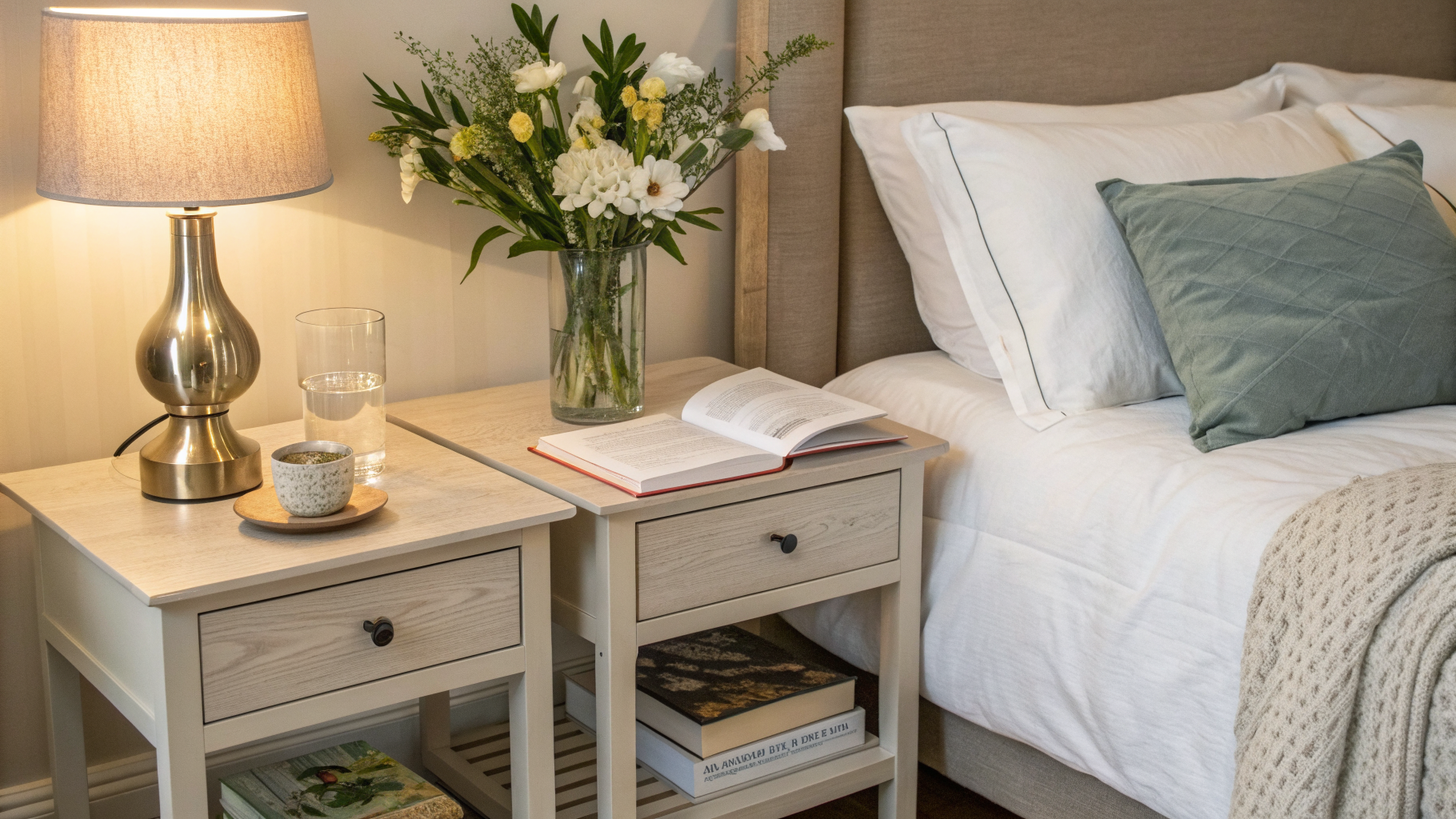
A bedside table is a small piece of furniture positioned next to a bed. It provides an accessible surface for items you may want to reach while you’re in bed.
Common items include:
- A bedside lamp
- Phone
- Alarm clock
- Glass of water
- Book
- Reading glasses
- Small decorative objects
Many bedside tables also include drawers, shelves, or cabinets for additional storage.
You’ll also see the terms nightstand and bedside table used interchangeably. Although furniture designs vary, both generally serve the same purpose.
How to Choose a Bedside Table
Instead of choosing a bedside table based only on appearance, consider four things first:
Height: Can you comfortably reach the surface from bed?
Width: Does it fit the available space beside the bed?
Storage: Do you need drawers, shelves, or simply a tabletop?
Style: Does it complement the bed and the rest of the room?
Start with measurements before shopping. This eliminates many options that may look attractive online but won’t work properly in your bedroom.
What Is the Best Height for Bedside Tables for Bedroom?
A useful starting point is to choose a bedside table with a top that sits approximately level with the top of your mattress.
It doesn’t need to align perfectly.
A nightstand that’s slightly higher or lower can still work comfortably, but a major difference in height may make items harder to reach from bed.
Measure Your Bed First
Measure from the floor to the top of your mattress.
Remember to measure the complete bed setup rather than looking only at the bed-frame dimensions.
Your mattress thickness and foundation can significantly affect the final sleeping height.
Once you know that measurement, compare it with the overall height listed for the bedside table.
How Wide Should a Bedside Table Be?
There isn’t one ideal width for every bedroom.
The right size depends primarily on:
- Bed size
- Available wall space
- Room dimensions
- Storage requirements
- Other nearby furniture
A compact bedside table can work well next to a twin or full bed or inside a small bedroom.
A larger nightstand may feel more proportional next to a king-size bed, particularly in a spacious room.
But proportion isn’t the only consideration.
You still need enough space to move around the bed comfortably and access nearby doors, closets, drawers, or windows.
Don’t Forget Bedside Table Depth
Width gets most of the attention, but depth matters too.
A deep bedside table may extend too far into a narrow walkway or make a small room feel crowded.
Before purchasing one, measure:
- Available wall width
- Distance between the bed and wall
- Available walking space
- Distance to nearby furniture
- Clearance for drawers and doors
Use the actual product dimensions rather than estimating from photographs.
Bedside Table With Drawers or Without?
Storage is one of the biggest decisions when choosing bedside furniture.
Bedside Tables With Drawers
Drawers are useful if you want to keep small items nearby without leaving them visible.
They can hold things such as:
- Charging cables
- Reading glasses
- Notebooks
- Medication
- Personal accessories
- Small electronics
Closed storage also makes it easier to maintain a clean-looking bedside area.
Bedside Tables With Open Shelves
Open shelving creates a lighter appearance and keeps frequently used objects accessible.
A lower shelf can hold:
- Books
- Decorative baskets
- Magazines
- Small storage boxes
The downside is that clutter remains visible.
Minimal Bedside Tables
If you only need space for a lamp, phone, and glass of water, you may not need storage at all.
A simple table can reduce visual weight and work particularly well in minimalist or small bedrooms.
Choose based on what you actually keep beside your bed rather than assuming more storage is always better.
Bedside Tables for Small Bedrooms
Small bedrooms require careful furniture choices because every inch of floor space matters.
Look for bedside tables with:
- Compact dimensions
- A narrow footprint
- Useful vertical storage
- One practical drawer
- Open legs
- Simple shapes
- Minimal decorative bulk
Before deciding that you don’t have room for a bedside table, measure the available space.
You may have enough room for a narrow design even when a conventional nightstand would be too large.
Use Vertical Space
A compact table with a drawer and lower shelf can provide useful storage without requiring a large footprint.
Another option is wall-mounted bedside storage.
Floating nightstands leave more floor visible and can make a compact bedroom feel less crowded.
Just make sure wall-mounted furniture is installed correctly for the wall type and expected load.
Do You Need Two Bedside Tables?
No.
Two matching bedside tables can create symmetry, but they aren’t a requirement for a well-designed bedroom.
Two Tables Work Well When:
- Two people use the bed
- Both sides of the bed are accessible
- The room has enough space
- You prefer a symmetrical appearance
One Table Can Work Better When:
- The bed sits close to a wall
- The bedroom is small
- Only one person needs bedside storage
- Other furniture occupies one side
Function should come before symmetry.
Don’t squeeze two pieces of furniture into a room simply because bedroom photographs often show matching nightstands.
Should Bedside Tables Match?
Your bedside tables don’t necessarily need to match each other.
They also don’t need to perfectly match the dresser or bed frame.
A bedroom can feel more natural when furniture coordinates without being identical.
You can create consistency through:
- Similar colors
- Matching hardware
- Repeated materials
- Similar proportions
- Complementary shapes
- Shared design styles
For example, two different wooden nightstands can work together if their finishes have similar undertones and their heights are reasonably close.
How to Match a Bedside Table With Your Bed
Think about visual weight and proportion.
A substantial upholstered bed may look balanced with bedside tables that have a little more presence.
A simple platform bed may pair better with lighter, streamlined nightstands.
You can also create contrast intentionally.
For example:
Wood bed + painted nightstand
Upholstered bed + wood nightstand
Black bed + natural wood nightstand
White bed + warm wood nightstand
The goal isn’t perfect matching. It’s creating a relationship between the pieces.
Choosing the Right Bedside Table Color
Color can influence how large or visually heavy the furniture appears.
White Bedside Tables
White can create a bright, clean appearance and works with many bedroom color schemes.
It pairs particularly well with:
- Natural wood
- Beige
- Gray
- Blue
- Sage
- Pastels
Black Bedside Tables
Black creates stronger contrast and can work well in modern, contemporary, industrial, and minimalist bedrooms.
In a small or dark bedroom, balance black furniture with lighter surrounding elements if you want to keep the room feeling open.
Natural Wood Bedside Tables
Natural wood introduces warmth and texture.
Don’t worry if your bed and nightstand aren’t exactly the same shade of wood. Mixing wood tones can create a more layered appearance when done intentionally.
Colored Bedside Tables
A bedside table can also introduce an accent color without dominating the bedroom.
Muted green, navy, soft blue, or warm neutral finishes can add personality while remaining easy to coordinate.
Bedside Table Materials
Material affects appearance, maintenance, weight, and price.
Solid Wood
Solid wood offers natural variation in grain and color.
Depending on its construction and finish, it can work with traditional, rustic, Scandinavian, Japandi, modern, and transitional interiors.
Engineered Wood
Engineered wood is widely used in affordable bedroom furniture.
Quality can vary, so examine the complete product rather than judging it by the material name alone.
Pay attention to:
- Drawer construction
- Hardware
- Surface finish
- Assembly method
- Weight capacity
- Manufacturer instructions
Metal
Metal bedside tables can create a lighter visual appearance, particularly when they have slim legs or open frames.
They’re often used in industrial, contemporary, and minimalist bedrooms.
Glass
Glass can reduce visual heaviness because it doesn’t create the same solid visual block as opaque furniture.
However, fingerprints and dust may be more noticeable, and you’ll need to consider the type of glass and manufacturer’s care instructions.
How Much Storage Do You Actually Need?
Before buying a bedside table with multiple drawers, think about what you keep beside your bed.
If the answer is only:
Phone + lamp + water + book
a simple table may be sufficient.
If you regularly need:
Chargers + medication + notebooks + glasses + electronics + personal items
one or two drawers may be worthwhile.
Extra storage is useful only when you actually use it. Otherwise, a larger nightstand simply consumes more bedroom space.
Bedside Lighting and Table Size
Your lamp should also influence your choice of bedside table.
A large lamp on a very small table can leave almost no usable surface area.
Before purchasing the table, think about what needs to fit on top.
For example:
Lamp + phone + glass of water + book
If those objects consume the entire surface, the table may be too small for your needs.
Wall-mounted sconces are another option when surface space is extremely limited.
They can free the tabletop for other essentials.
Where Should a Bedside Table Be Positioned?
Most bedside tables are positioned close enough to the mattress to be reached comfortably.
However, avoid forcing the furniture tightly against everything around it.
Consider clearance for:
- Bed frames
- Drawers
- Closet doors
- Bedroom doors
- Curtains
- Electrical outlets
- Baseboard heaters or vents
You should also make sure drawers and cabinet doors can open fully.
A table technically fitting into a gap doesn’t necessarily mean the layout will function well.
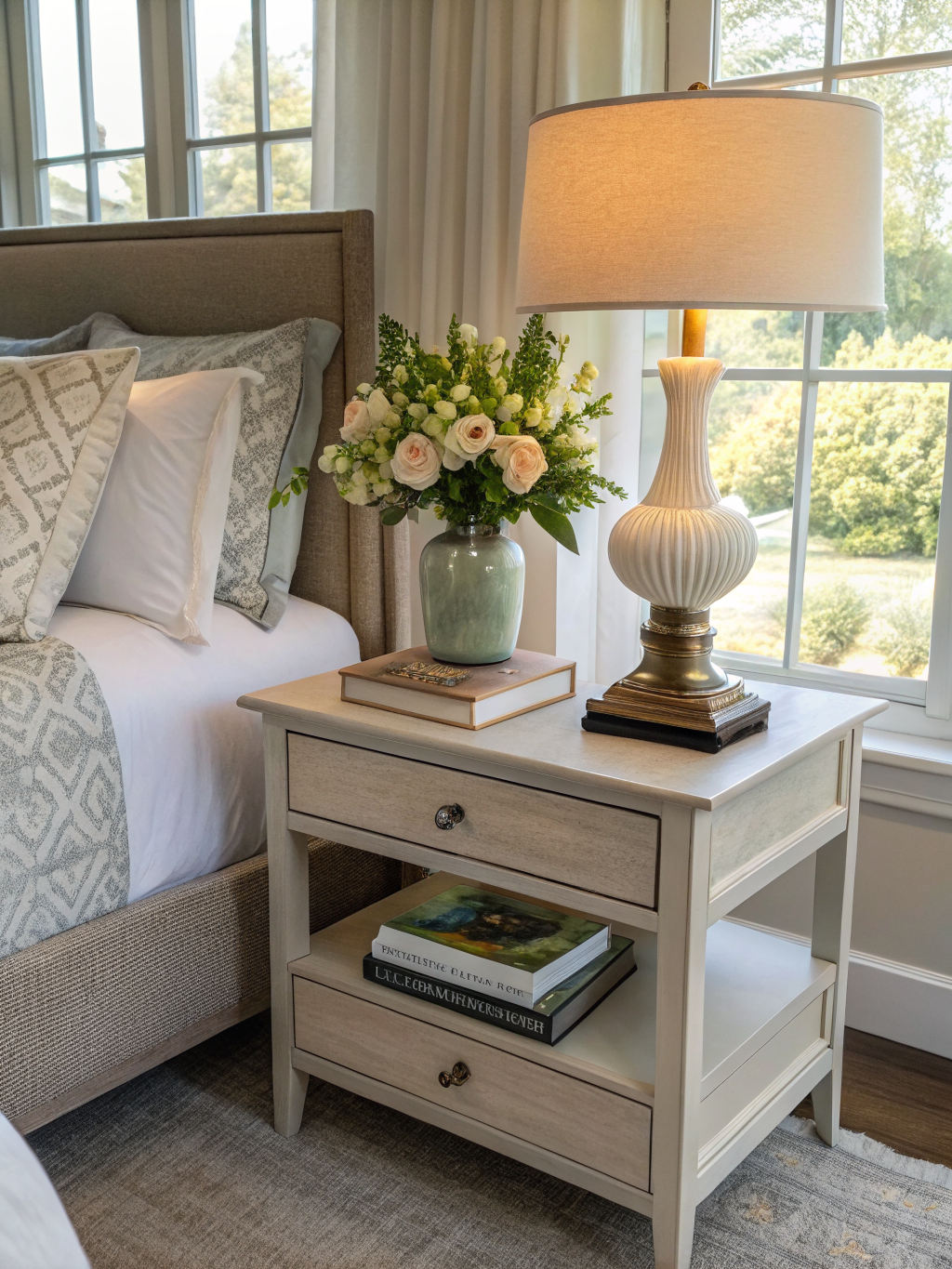
How to Style a Bedside Table
You don’t need to fill every inch of the tabletop.
A practical bedside arrangement might include:
- Lamp
- Small tray
- Book
- Plant or flowers
- One decorative object
Try varying object heights instead of placing several similarly sized pieces in a row.
Most importantly, preserve some empty space.
Your bedside table is functional furniture. You should still have room to place your phone, glasses, or a glass of water.
Common Bedside Table Mistakes
Choosing the Table Before Measuring the Bed
Always know your mattress height before choosing a nightstand.
Otherwise, you may end up with a table that’s uncomfortable to reach.
Buying a Table That’s Too Large
A large nightstand can overwhelm a small bedroom and reduce walking space.
More storage isn’t always worth sacrificing comfortable movement.
Ignoring Drawer Clearance
Make sure drawers can open without hitting the bed, wall, curtains, or other furniture.
Prioritizing Matching Over Function
Two perfectly matching tables aren’t useful if one blocks a doorway or makes the room too crowded.
Choosing Too Little Surface Area
A very narrow table may look elegant but become frustrating if your lamp occupies almost the entire surface.
Overdecorating
A bedside table covered with decorative objects leaves little room for the things you actually use.
Bedside Tables for Different Bedroom Styles
Modern Bedrooms
Look for:
- Clean lines
- Simple hardware
- Smooth surfaces
- Minimal decoration
Scandinavian Bedrooms
Consider:
- Light wood
- White finishes
- Simple shapes
- Functional storage
Japandi Bedrooms
Choose pieces with:
- Natural materials
- Warm neutral finishes
- Simple silhouettes
- Minimal visual clutter
Traditional Bedrooms
Consider:
- Wood finishes
- Detailed drawer fronts
- Classic hardware
- More substantial proportions
Industrial Bedrooms
Look for combinations of:
- Wood
- Metal
- Dark finishes
- Simple construction
Your bedside table doesn’t need to perfectly follow a named design style. These categories are simply useful starting points.
Quick Bedside Table Buying Checklist
Before buying, check:
- Overall height
- Mattress height
- Width
- Depth
- Available floor space
- Drawer clearance
- Number of drawers
- Internal storage dimensions
- Tabletop size
- Lamp dimensions
- Material
- Hardware
- Assembly requirements
- Manufacturer’s weight limits
- Color and finish
Taking these measurements before ordering can prevent many common furniture-buying mistakes.
Frequently Asked Questions
How high should a bedside table be?
A useful starting point is approximately level with the top of your mattress. A slightly higher or lower table can still be comfortable, so consider how easily you can reach the surface while in bed.
Should bedside tables be higher than the bed?
They can be slightly higher. The most important consideration is comfortable access rather than achieving an exact visual alignment.
How wide should a bedside table be?
The appropriate width depends on the bed, available space, and storage requirements. Measure the gap beside your bed and make sure you preserve comfortable movement around the room.
Do bedside tables have to match the dresser?
No. The furniture can coordinate through color, material, hardware, shape, or overall style without matching exactly.
Do you need a bedside table on both sides of the bed?
No. Two tables are useful when two people use the bed and space allows, but a single bedside table can work perfectly well in a smaller bedroom.
What type of bedside table is best for a small bedroom?
Look for compact designs, narrow tables, floating nightstands, or pieces that use vertical storage efficiently. Measure carefully before buying.
Is a bedside table the same as a nightstand?
The terms are commonly used interchangeably. Individual designs may differ, but both generally describe small pieces of furniture positioned beside a bed.
Final Thoughts
Choosing the right bedside tables for bedroom spaces comes down to balancing size, comfort, storage, and style.
Start by measuring your mattress height and the available space beside your bed. Then determine how much storage and tabletop space you actually need.
In a small bedroom, a compact nightstand or floating design may be enough. In a larger room, a wider bedside table can provide additional storage and help balance the proportions of a substantial bed.
Most importantly, don’t choose a bedside table simply because it matches your other furniture.
Choose one that fits your room, is comfortable to reach, provides the storage you need, and contributes to a bedroom that feels organized and intentional.