
“This post contains affiliate links. If you click and buy, we may earn a small commission at no extra cost to you. See our Affiliate Disclaimer for details.”
A lumbar pillow is the small rectangular one, usually 12 by 20 inches or 14 by 24 inches, that sits in front of the two larger square pillows on a bed or sofa. It looks like an afterthought. It isn’t. That final horizontal shape is what makes the arrangement read as finished instead of stacked, and getting it wrong is why a lot of sofas look busy and a lot of beds look flat.
The problem most people run into is treating the lumbar as decoration first and support second, or the opposite, which produces a pillow that either flops forward every time someone sits down or props the lower back at an angle nobody actually wants. Good Lumbar Pillow Styling resolves both jobs at once. This guide walks through how to size it, fill it, place it, and pair it so the pillow works when you sit against it and still looks intentional when you don’t.
Table of Contents

The two-job rule for every lumbar pillow
Every lumbar pillow has two jobs: a support job and a shape job. The support job is physical. It fills the gap between the lower back and the seat back, or between the shoulders and the headboard, so the body doesn’t have to hold itself up. The shape job is visual. It introduces a horizontal line that breaks up the vertical stack of larger square pillows and pulls the eye across the piece of furniture.
A pillow that only does the shape job is too soft or too thin to lean on, and it slides out of place. A pillow that only does the support job usually looks like it came off an office chair. The trick is to pick fill, size, and cover so both jobs happen in one object. Once you can name which job a pillow is failing at, every fix in the rest of this article becomes obvious.
Sizing the pillow to the furniture, not the pile
The pillow’s length should relate to the piece it sits on, not the other pillows around it. On a standard queen bed with two king or two euro shams behind it, a 14 by 36 inch lumbar reads as proportional. Go smaller, around 12 by 20, and it starts to look like a travel pillow lost on the mattress. On a king bed, aim for 16 by 40 or larger so the horizontal line actually spans a meaningful portion of the headboard.
Sofas follow a different logic. On a three-seat sofa around 84 inches wide, a single 14 by 24 lumbar centered on the middle cushion works, or two 12 by 20 lumbars, one on each end, tucked into the corner where the arm meets the back cushion. Anything shorter than 20 inches on a full-size sofa tends to look like a sample.
Choosing the fill that matches the job
Fill decides whether the pillow holds its shape when leaned on. There are three practical options.
- Feather and down, 10/90 or 25/75 blend: softest, molds to the lower back, needs a daily karate chop to look intentional, best for beds and low-traffic sofas.
- Feather and down with a foam core: holds a rectangular silhouette, supports the lumbar spine reliably, ideal for sofas people actually sit on.
- Polyester fiberfill: cheapest, keeps a puffy shape but compresses quickly and rarely feels supportive after a few months.
Match the insert to the cover size plus one to two inches. A 14 by 24 cover wants a 15 by 25 or 16 by 26 insert so the corners fill out and the pillow doesn’t sag in the middle. Undersized inserts are the single most common reason a well-chosen cover looks limp.
Placing the pillow so it stays where it belongs
On a bed, the lumbar sits in front of the sleeping pillows and sham layer, roughly centered, with its bottom edge one to two inches above the top edge of the folded-down duvet or coverlet. That small gap lets the pillow read as a distinct layer rather than melting into the bedding. If the headboard is tall, over 55 inches from the mattress, the lumbar can sit slightly higher and lean back into the shams. On a short or no headboard setup, tuck it lower so it doesn’t look like it’s floating.
On a sofa, the lumbar belongs where a person’s lower back lands when they sit fully back. That’s usually about 8 to 10 inches up from the seat cushion. Corners are the other honest location, wedged where two back cushions meet. Dead-center on a long sofa, with nothing flanking it, tends to look stranded.
Pairing the lumbar with the rest of the Decorative Pillows
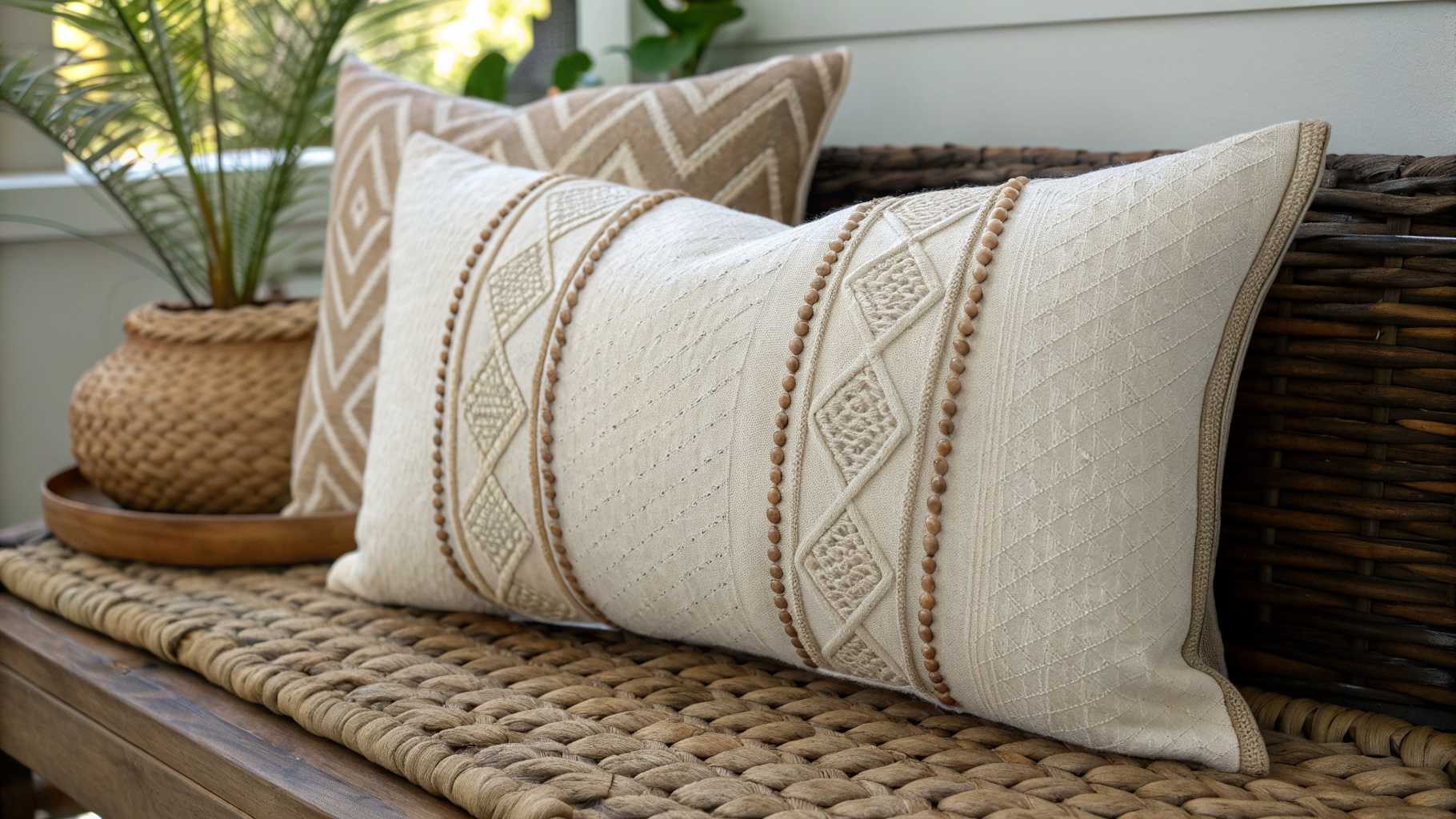
The lumbar’s job in a pillow arrangement is to be the shortest, widest, and usually the most decorative piece. That means it can carry the pattern, the fringe, the embroidery, or the contrast color, while the pillows behind it stay quieter. Reverse that hierarchy and the arrangement fights itself.
A workable formula for a bed: two euro shams in a solid or subtle texture, two standard shams in a secondary color or small pattern, and one lumbar with the boldest fabric of the three layers. For a sofa, keep it simpler. Two 22 inch square pillows in a textured solid at the corners, and a single lumbar in a pattern that picks up one color already in the room, usually works better than four mismatched squares plus a lumbar competing for attention. A small collection of well chosen Decorative Pillows in coordinating tones will outperform a large pile of unrelated covers every time.
Texture matters as much as color. If the sofa is smooth, a bouclé or heavy linen lumbar adds contrast. If the sofa is already textured, like a chunky weave, a smoother velvet or cotton lumbar keeps the surface from getting noisy.
The most common lumbar pillow mistake
The frequent error is buying a lumbar cover that’s beautiful, stuffing it with the insert that came in the package, and calling it done. That insert is almost always the same nominal size as the cover, sometimes smaller, and usually polyester. The result is a pillow with soft corners, a saggy middle, and no support. It photographs acceptably for about a week, then flattens.
The fix is to buy the cover and the insert separately. Size the insert one to two inches larger than the cover in both dimensions, and choose feather-down or a feather-down-with-foam-core insert if the pillow will actually be leaned on. This one adjustment resolves most of the complaints people have about lumbar pillows looking limp or refusing to stay upright.
Where to start
- Measure the piece of furniture first, then pick a lumbar length proportional to it, not to the other pillows.
- Buy the cover and insert separately, sizing the insert one to two inches larger.
- Choose feather-down with a foam core for any sofa that gets daily use.
- Place the pillow where a lower back actually lands, not where it looks centered in a photo.
- Let the lumbar carry the pattern and keep the pillows behind it quieter.
- For a full walkthrough of coordinating pillows with headboards, bedding, and nightstands, see our guide to bedroom design and layout.
The decision that matters most is which job the pillow is primarily doing in your room. A lumbar on a guest bed nobody sits up in can be soft, decorative, and light on support. A lumbar on the sofa where someone reads every evening needs a firmer insert and a cover that can handle being crushed and reshaped every night. Buy for the actual use, and the styling choices narrow themselves.