
“This post contains affiliate links. If you click and buy, we may earn a small commission at no extra cost to you. See our Affiliate Disclaimer for details.”
A typical bath towel measures 27 by 52 inches and, when folded in thirds, still occupies a stack roughly 14 inches wide and 4 inches tall per towel. Multiply that by four people, add hand towels and washcloths, and the pile competes for space with the toilet paper, the hair dryer, and everything else that used to live behind a louvered door you no longer have. Rentals built before 1970, converted attics, and most urban studios simply skipped the linen closet.
That absence forces a decision most homes never make: where do clean towels actually live, and where do wet ones dry?
This guide walks through a workable approach to bathroom towel storage when the room offers no dedicated closet, covering the framework, the wall zones you have available, the furniture that earns its footprint, the drying question, and the mistake that quietly ruins most first attempts.
Table of Contents

The wet-dry-reserve split
Every towel in your home is in one of three states, and each state needs a different kind of storage. Confusing them is why bathrooms without a linen closet feel chaotic even after someone adds hooks.
Wet towels have just been used and need airflow on both sides. A hook or a single bar works. A stack does not, because a damp towel pressed against another damp towel stays damp for a day and a half.
Dry towels are the ones in rotation but not currently in use. They can be folded, rolled, or hung, and they need to stay clean and visible. This is the pile that usually ends up on the back of a chair in the bedroom.
Reserve towels are guest towels, beach towels, and the second set. They can be compressed, boxed, or moved out of the bathroom entirely.
Solve for all three, in that order, and the room stops feeling short on space. Solve only for wet, which is what most quick-fix articles do, and the other two states leak into every flat surface you own.
Mapping the wall zones you actually have
Before buying anything, walk into the bathroom and identify five wall zones: behind the door, above the toilet, the wall beside the shower, the wall above the towel bar (if one exists), and the vertical strip between the sink and the corner. Most bathrooms without a linen closet have at least three of these unused.
Behind the door is the highest-yield zone in a small bathroom. An over-the-door rack with four or five hooks holds wet towels for a family without touching the walls, which matters in rentals. Look for one rated for a door thickness between 1 3/8 and 1 3/4 inches, which covers most interior doors.
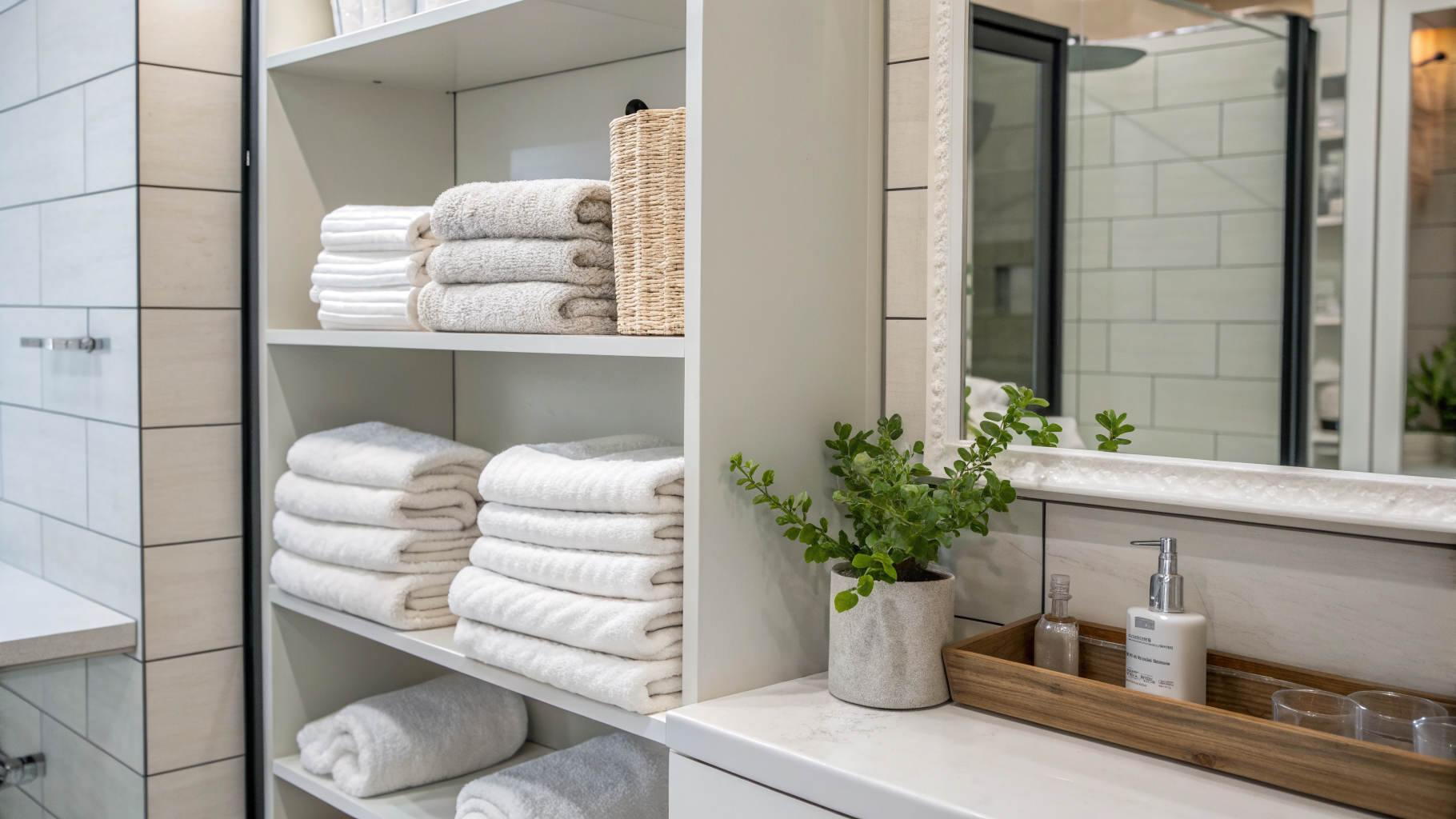
Above the toilet, the wall is usually blank from the tank up to the ceiling, offering roughly 36 to 48 inches of vertical space. This is where a wall-mounted cabinet or a set of three floating shelves at 24 inches wide handles the dry-towel pile. Keep the lowest shelf at least 10 inches above the tank lid so lifting it for repairs stays possible.
Furniture that earns its footprint
When wall storage runs out, a single piece of freestanding furniture can absorb the rest. The trick is choosing one that gives back more than it takes.
A narrow ladder shelf, roughly 16 to 18 inches wide with four tiers, fits into the strip beside a toilet or between the sink and the wall. Rolled towels sit on the lower rungs, jars and baskets on the upper ones. Because the frame leans, its actual floor contact is smaller than the shelf area, which is why it works in tight rooms where a boxy cabinet would not.
A slim bathroom tower cabinet with a footprint around 12 by 12 inches and a height of 65 inches gives you closed storage for the reserve pile plus one or two open shelves for daily items. Look for adjustable interior shelves, because a fixed 8-inch spacing wastes room when your folded stack is 4 inches tall.
For a genuinely tiny room, a wall-hung vanity with an open lower shelf converts the space under the sink from awkward plumbing zone to visible towel storage. A stack of three rolled bath towels fits in roughly a 12-inch cube.
The drying question most guides skip
A wet towel needs air on both sides to dry in under twelve hours. This is the constraint that quietly determines your whole layout, and it is the reason a heated towel rail exists as a product category.
If your bathroom has no window and no exhaust fan that runs long enough, folded storage will smell within a week no matter how nicely arranged. In that case, prioritize hanging space over shelf space. A wall-mounted swing-arm towel rack with three or four arms lets each towel hang separately with air gaps between them, and it folds flat against the wall when not in use.
Hooks are more forgiving than bars for wet towels because a towel on a hook bunches at the top and hangs open below, exposing more surface area. A bar folds the towel in half against itself, which halves the drying rate. If you use bars, space them so towels do not overlap, which usually means one towel per 12 inches of bar length.
For a fuller catalog of hanging configurations, this guide to towel storage small bathroom setups covers rail and hook variations worth reviewing before drilling.
The mistake that ruins most first attempts
The common error is treating bathroom towel storage as a single problem and solving it with one product, usually an over-the-toilet etagere loaded with folded towels, decorative baskets, and a plant.
The problem is that this piece serves only the dry-reserve function and does nothing for wet towels, which then migrate to the shower door, the radiator, or the floor. Meanwhile the etagere itself collects dust because folded stacks in a humid room absorb moisture and start to smell before the rotation reaches the bottom of the pile.
The fix is to separate the wet solution from the dry solution physically. Hooks or a rail for wet, on one wall. Shelves or a cabinet for dry, on a different wall or above the toilet. Reserve towels compressed into a bin under the sink or moved to a bedroom closet. Three zones, three products, no overlap.
Where to start
- Count the towels in daily rotation and separate them into wet, dry, and reserve piles.
- Install hooks or a swing-arm rack for the wet count before buying any shelving.
- Claim the wall above the toilet with a cabinet or three shelves at 24 inches wide.
- Add one narrow freestanding piece only if the wall zones cannot hold the dry pile.
- Move reserve towels out of the bathroom entirely if humidity is high and ventilation is weak.
- For related layout and fixture decisions in the rest of the room, the full bathroom section covers the surrounding choices.
The decision that matters most is the wet-versus-dry split, because it determines whether you need more hanging length or more shelf area, and those two answers pull the room in opposite directions. Measure the wet count first. Everything else follows from that number.