
“This post contains affiliate links. If you click and buy, we may earn a small commission at no extra cost to you. See our Affiliate Disclaimer for details.”
A 9-by-10-foot bedroom can quickly feel overcrowded when furniture is chosen without considering scale. A large dresser, oversized nightstands, or a bulky bed frame may fit on paper but leave very little comfortable walking space. Measuring the room and planning the furniture layout before buying anything can prevent this problem. Most small bedroom layout mistakes come down to fighting the room instead of working with it. Here are the nine I made, or watched friends make, and the specific fix for each one so you can skip the month of frustration I didn’t.
Table of Contents
Why Layout Beats Square Footage in a Small Bedroom
A small room can feel open or suffocating at the exact same size, and the difference is almost never how much stuff you own. It’s placement, sightlines, and how much floor your eye can see when you walk in. Two rooms with identical dimensions can feel a foot apart in either direction depending on where the bed sits and how tall the furniture is.
That’s the good news. You rarely need a bigger room. You need a smarter arrangement, and most of the fixes below cost nothing but an afternoon of moving things around.
1. Pushing the Bed Into the Corner
Shoving the bed lengthwise against two walls feels like it saves space, and it does save a little floor, but it makes the bed a pain to use and the room feel lopsided. Climbing over someone to get out of bed gets old fast, and one wall of furniture with a big empty patch opposite reads as unbalanced.
Center the bed on your longest wall if you possibly can, with a little clearance on both sides. Even a narrow gap on each side lets you make the bed properly and gives the room symmetry, which the eye reads as calm. In a genuinely tiny room, one side against the wall is a fair compromise, but avoid the two-wall corner unless you have no other option.
2. Buying Furniture That’s Too Tall
A tall dresser or a towering headboard eats visual space even when it doesn’t touch the floor you walk on. Height draws the walls inward and makes the ceiling feel lower. I had a 54-inch highboy dresser in my first small room and it loomed over everything.
Go low and long instead. A wide, low dresser stores the same amount but keeps your sightline open across the top of the room, which makes the walls feel further apart. The same logic applies to the bed frame, which is why a low-profile bed frame almost always suits a small bedroom better than a tall upholstered one.
3. Blocking the Path to the Window
Natural light is the single biggest ally a small room has, and people block it constantly. A dresser under the sill, a chair in front of the glass, a bed that cuts across the window all steal the light that would otherwise make the room feel bigger.
Keep the area around your window as clear as you can. If furniture has to go near it, choose something low enough to sit below the sill so the light still pours over the top. An unobstructed window does more for a small room than any mirror or paint trick.
4. Using a Rug That’s Too Small
A little rug floating in the middle of the floor is the most common sizing mistake I see, and it shrinks the room instead of grounding it. A 3×5 rug marooned under the foot of the bed looks like a bath mat and chops the floor into awkward pieces.
Size up and slide it partly under the bed. A rug that extends at least 18 to 24 inches out from the sides and foot of the bed pulls the whole layout together and makes the floor read as one continuous surface. In a small room, a bigger rug counterintuitively makes the space feel larger, not smaller.
5. Cluttering Every Surface
Every flat surface in a small room is a temptation, and a full nightstand, a crowded dresser top, and a windowsill lined with objects add up to visual noise that makes the room feel busy and tight. The eye has nowhere to rest.
Clear your surfaces down to a few intentional items each and store the rest out of sight. My rule is a lamp plus one other thing on the nightstand, and no more than three items on the dresser top. Empty surface is a luxury a small room should spend on itself.
6. Choosing Heavy Window Treatments
Thick, dark curtains that stop at the windowsill make a small window look smaller and a small room look boxed in. Short curtains cut the wall in half horizontally, which lowers the whole room visually.
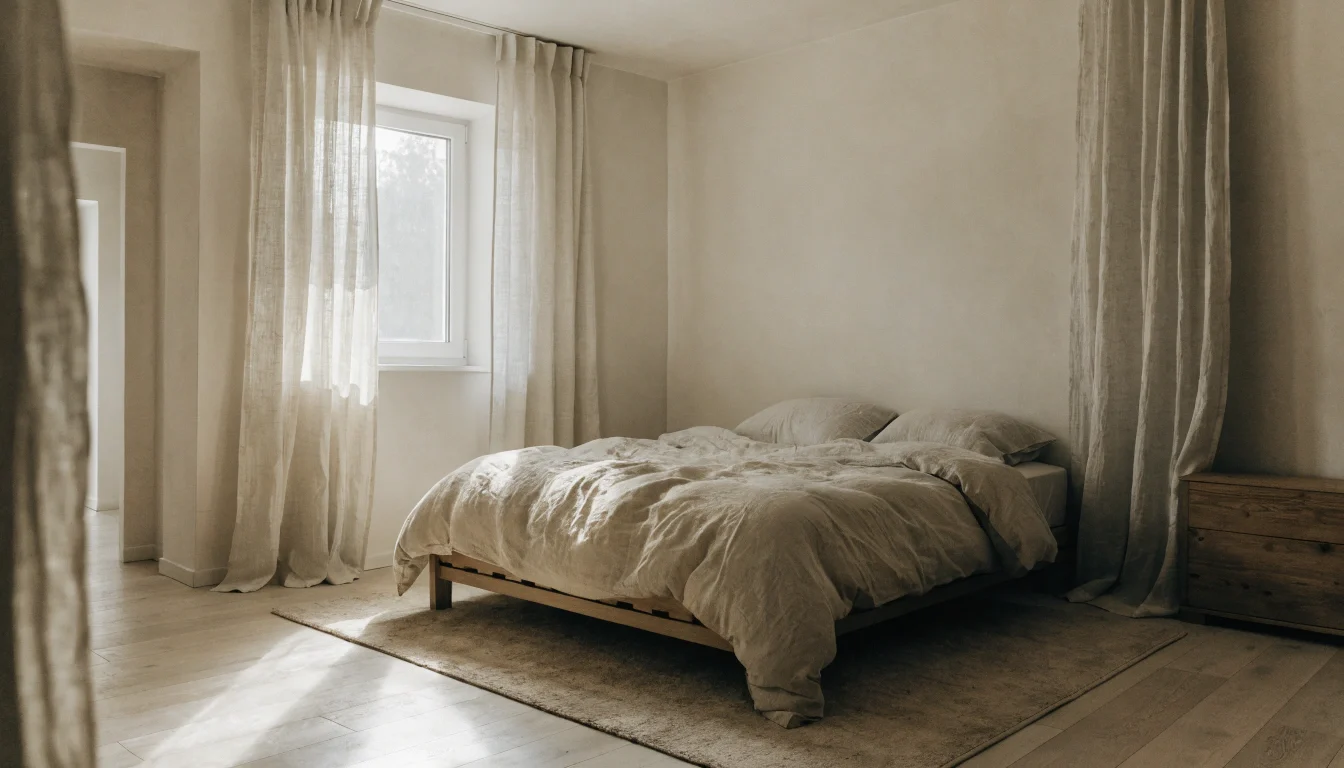
Hang curtains high and wide, close to the ceiling and extending past the window frame on both sides, in a light, airy fabric. Mounting the rod near the ceiling draws the eye up and makes the wall feel taller, and letting the panels fall to the floor adds an unbroken vertical line that stretches the room.
7. Ignoring the Space Under the Bed
In a small bedroom, the area under the bed is the most wasted storage in the house. Leaving it empty while your closet overflows and bins pile up in the corner is a missed opportunity that costs you floor space elsewhere.
Use flat under-bed storage for off-season clothes, spare linens, and anything you reach for rarely. A bed frame with built-in drawers does this cleanly, and clearing the corners of a room by moving that overflow under the bed is one of the fastest ways to open up the floor.
8. Overfilling the Room With Too Many Pieces
A small bedroom does not need a bed, two nightstands, a dresser, a chair, a bench, and a bookshelf. Every extra piece is another thing the walls have to accommodate, and past a certain point you’re just navigating an obstacle course to reach the bed.
Decide what the room actually needs and cut the rest. In most small bedrooms that’s a bed, one or two slim nightstands, and a single dresser. The reading chair you never sit in is stealing space a clear floor would use better. Fewer, well-chosen pieces always beat a room crammed with furniture.
9. Getting the Scale of Everything Wrong Together
This is the mistake that ties the others together, and it’s the one that cost me the most. I furnished my first small bedroom with hand-me-downs that were each fine on their own but wildly mismatched in scale, a big bed, a tiny nightstand, an oversized dresser, a floor lamp that dwarfed the lot. Nothing related to anything else, and the room felt chaotic no matter how much I cleaned.
Aim for pieces that relate in height and weight. Furniture that sits at similar levels creates a calm horizontal line around the room, and that consistency is what makes a small space feel deliberate instead of accidental. It took me two rounds of returns to learn that a room reads as a whole, not as a collection of individual objects.
Quick Fixes You Can Do This Weekend
If you want the fastest wins from this list, start with these:
- Move the bed off the corner and onto your longest wall
- Rehang curtains near the ceiling and let them reach the floor
- Size up your rug and slide it under the bed
- Clear every surface down to two or three items
- Fill the under-bed space and empty a corner
None of those cost much, and together they change how the room feels before you buy a single new thing. The one I’m still working on in my current place is the furniture-scale problem from mistake nine, because I’m slowly replacing mismatched hand-me-downs one piece at a time as the budget allows, and living with a half-matched room in the meantime. It’s a slower fix than the others, but it’s the one that makes the biggest difference once it’s done.