
“This post contains affiliate links. If you click and buy, we may earn a small commission at no extra cost to you. See our Affiliate Disclaimer for details.”
A beige bedroom can look minimalist without actually feeling calm. When a room is stripped of too much texture, warmth, and personality, simplicity can quickly start to feel empty instead of intentional.
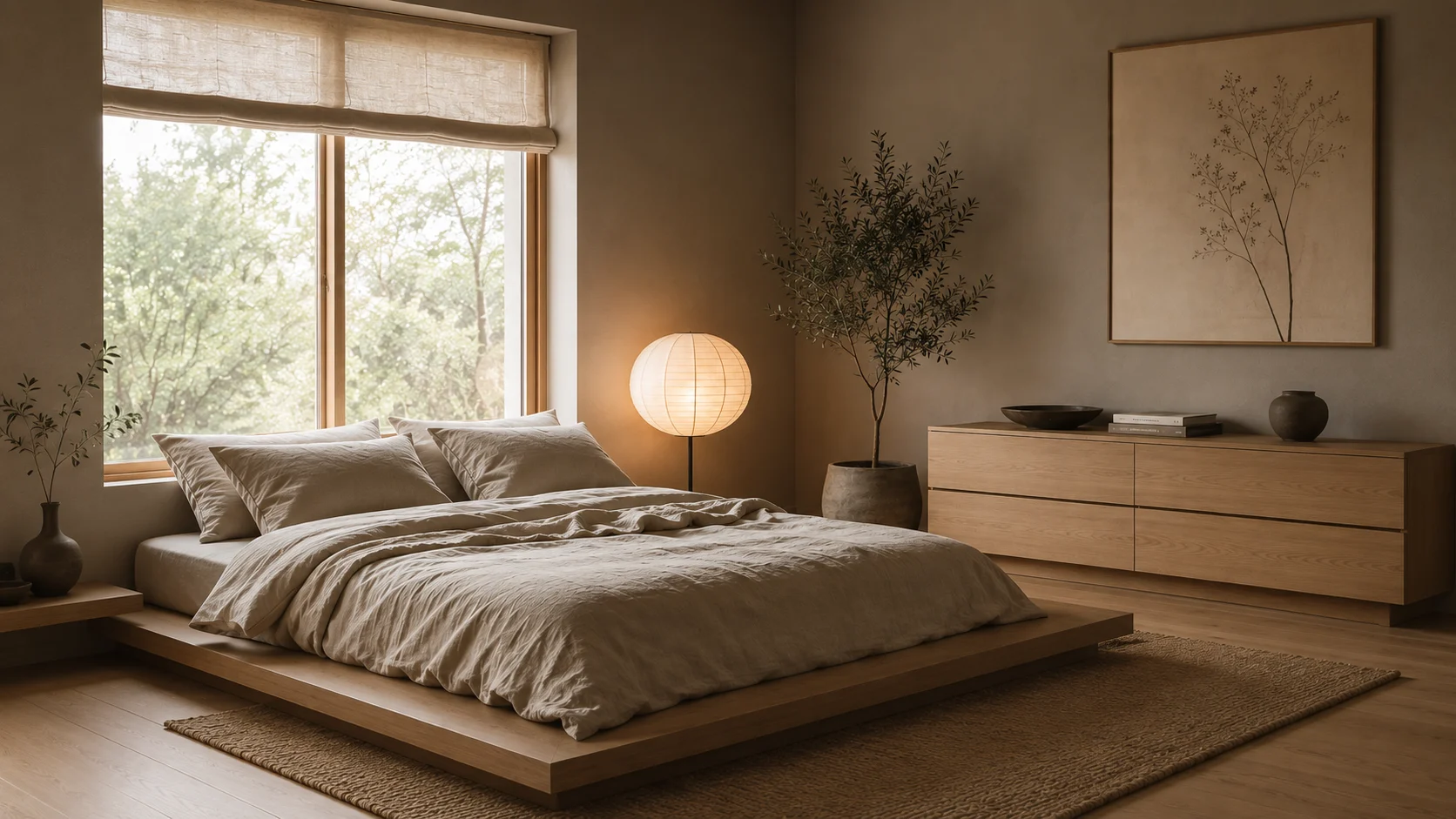
That’s where Japandi bedroom ideas can make a real difference. By combining Japanese restraint with Scandinavian warmth, Japandi design creates spaces that feel simple and uncluttered without becoming cold or lifeless. Natural materials, soft textures, warm neutrals, thoughtful lighting, and carefully chosen furniture all contribute to the effect.
The good news is that creating a Japandi-inspired bedroom doesn’t require replacing everything you own. A few thoughtful changes can transform the atmosphere of the room. Here are practical Japandi bedroom ideas to help you create a space that feels warm, balanced, and genuinely restful.
Table of Contents

What Japandi Bedroom Actually Is (and Isn’t)
Before the list, it helps to know what you’re aiming at, because the word gets thrown around loosely. Japandi is the overlap between two design traditions that already agree with each other. Japanese design values wabi-sabi, the beauty of imperfect and natural things, and empty space as a feature. Scandinavian design values hygge, warmth and function and light-toned wood.
Put them together and you get a room that is spare but never cold. That is the tightrope. A Japandi bedroom is minimalist in count but rich in texture, neutral in color but warm in feel. If your room ends up looking like a hotel lobby, you leaned too Scandinavian and forgot the soul. If it feels bare and a little sad, you leaned too far into empty and forgot the warmth.
1. Start With a Low Bed
The fastest way to signal Japandi is height, or the lack of it. A low platform bed sits closer to the floor and makes the ceiling feel taller, which does more for a small room than any amount of clever storage. I found a solid oak platform frame on sale for around $340, and dropping my sleeping height by about eight inches changed the whole proportion of the room.
Look for a frame with visible wood grain and simple legs or a solid base. Avoid anything upholstered in a busy fabric or finished in high-gloss black. The bed is the largest object in the room, so if it gets the tone right, half your work is done before you touch anything else.
2. Give the Bed Room to Breathe
Leave space around the frame if you can. A bed shoved into a corner fights the calm you’re after, and Japandi lives on negative space. Even six inches of clearance on the far side reads as intentional instead of crammed, Leaving visible space around the bed can make a compact room feel less crowded. Even a small amount of clearance on the far side helps the layout look more intentional and makes it easier to move around the room..
If your room is genuinely tiny and the bed has to go against a wall, keep the other three-quarters of the room as open as possible to compensate. The eye needs somewhere to rest, and empty floor is that resting place.
3. Build a Warm Neutral Base
Japandi leans neutral, but flat white walls tip into clinical fast. Japandi interiors usually benefit from warm neutrals rather than stark white or cool gray. A warm greige such as Benjamin Moore Pale Oak can add subtle warmth while maintaining a calm, understated backdrop. Cool grays photograph well and live badly, so test a sample on your actual wall before committing to a whole gallon.
Paint sheen matters more than people expect here. A matte or eggshell finish absorbs light softly and suits the muted mood, while satin and semi-gloss bounce light in a way that feels harder and more modern. For a Japandi bedroom, flatter is almost always better.
Colors That Work as a Base
- Warm white with a beige undertone (not a blue-gray one)
- Greige, the greige-beige middle ground
- Soft clay or muted terracotta on a single accent wall
- Muted sage or eucalyptus for a cooler, still-warm option
- Charcoal or deep walnut for one grounding dark element
4. Layer Your Neutrals Instead of Matching Them
Matching every tone flattens a room. A bone bedsheet, an oatmeal throw, a slightly darker sand cushion, all sitting together, is what makes a simple palette look designed rather than unfinished. The variation between tones is the point, not a mistake to correct.
The way I check this now is to squint at the bed. If everything blurs into one flat block of color, I add a tone a few shades off. If it looks busy, I pull one thing out. You want three or four related neutrals in conversation, not one repeated five times and not eight fighting.
5. Let Texture Carry the Interest
Color stays quiet in this style, so texture does the heavy lifting. A room with five shades of the same beige can still feel rich if the surfaces are varied enough. These are the materials I keep coming back to:
- Linen bedding, wrinkled and unironed on purpose
- Raw or lightly finished wood (oak, ash, walnut)
- A wool or jute rug with a low pile
- Handmade ceramic in a lamp base or small dish
- Woven rattan or a paper lantern shade
- Nubby boucle or a chunky knit throw for contrast
Mix at least three of these and the room stops looking flat. Linen is the one I would start with, because it works hardest, softening the whole bed the moment it goes on.
6. Fix the Lighting Before You Buy Anything Else
One harsh ceiling light will undo every calm choice you make. I unscrewed my bright overhead bulb, dropped in a 2700K warm bulb, and the room softened before I spent another cent. Lighting temperature is the cheapest, most overlooked lever in the whole style.
Check the Kelvin rating on any bulb you buy. Anything labeled 2700K to 3000K gives that warm, candle-adjacent glow. Anything at 4000K or above pushes blue-white and belongs in a garage, not a bedroom you want to relax in.
7. Use Two or Three Low Light Sources
Aim for pools of light instead of one bright center. A small table lamp, a paper lantern floor lamp I picked up for about $55, and a single candle give you layers that feel restful after dark. A room lit from several low points always reads calmer than one lit from above.
Paper and rice-paper shades are a Japandi signature for a reason. They diffuse light into a soft glow instead of a hard beam, and the material itself fits the natural, handmade feeling the whole style is built on.
8. Choose Closed Storage That Hides Clutter
Minimalism fails the moment your surfaces fill up. A low wooden dresser with clean fronts and no visible hardware keeps everything out of sight and doubles as a spot for one lamp and one object, nothing more. If you’re choosing a piece, a low wooden dresser with clean handleless fronts is the quiet workhorse of a Japandi bedroom.
Push-to-open drawers or recessed finger pulls keep the fronts clean and unbroken, which is the detail that separates a Japandi dresser from an ordinary one. If your current dresser has chunky knobs, swapping them for flush pulls is a cheap weekend upgrade that changes the whole look.
9. Follow the Three-Item Surface Rule
A simple way to prevent a dresser from becoming cluttered is to limit the number of objects displayed at once. A lamp, small tray, and one decorative piece can provide enough visual interest while preserving empty space. A lamp, a small tray, one ceramic dish, and then I stop, which is harder than it sounds and worth every bit of the restraint.
The trick behind the rule is grouping in odd numbers and varying height. A tall lamp, a medium stack of two books, a low dish reads as a considered vignette. Five things of the same height read as clutter no matter how nice each one is.
10. Bring in One or Two Plants
A purely minimalist room can read like a showroom nobody lives in. One or two plants fix that instantly. A snake plant or a small olive tree brings in an organic shape without demanding much care, and the green against neutral wood is the single most-saved detail whenever I post my room online.
Sculptural, simple plants suit the style better than bushy, busy ones. A snake plant, a ZZ plant, an olive tree, or a single branch in a tall vase all give you the organic note without visual noise. One statement plant beats five small scattered ones.
11. Keep the Planters Quiet
The pot matters as much as the plant. A matte stoneware planter in sand or charcoal belongs; a glossy bright ceramic pulls focus and breaks the mood you built. I swapped a shiny white pot for a rough clay one and the corner finally looked deliberate.
Unglazed terracotta, matte stoneware, and raw concrete all sit comfortably in a Japandi room. If a pot shines or shouts a color, it’s working against you, no matter how healthy the plant inside it looks.
12. Mind Your Furniture Proportion
Here’s the thing I got wrong. A tall or bulky nightstand can look disproportionate beside a low-profile bed. A slimmer nightstand positioned close to mattress height usually creates a more balanced relationship between the two pieces.
Scale matters more than the individual piece in this style, and a beautiful item at the wrong height ruins the line of the whole room. Before you buy anything, measure the height of your mattress top and use it as your reference point. Nightstands and low dressers should sit near that line, not tower over it.
13. Keep the Floor as Clear as Possible
Visible floor equals visual calm. The more of it you can see, the larger and quieter the room feels, which is why a low bed and leggy furniture help so much. I cleared everything from around my bed except one flat jute rug, and the openness did more than any purchase.
A low-pile natural rug grounds the bed without adding bulk. Jute, wool, or a flatweave in a neutral tone anchors the space and adds one more texture at ground level, where a thick shag would only crowd it.
14. Hide the Overflow in Natural Baskets
If you need floor storage, keep it low and tucked. A single woven basket for extra blankets is enough, and it adds one more natural texture while it does its job. Two baskets start to clutter; one earns its place.
Seagrass, rattan, and undyed cotton rope baskets all fit the material story. They hide the things you actually use every day, the spare pillow, the throw, the book you finished, without breaking the calm surface of the room.
15. Edit Ruthlessly, Then Stop
The last step is knowing when to quit. Japandi is as much about what you remove as what you add, and the temptation to keep tweaking never fully goes away. Once the room feels quiet, leave it alone for a couple of weeks before deciding anything else needs to change.
A useful final test is how the room feels when you enter it. If the space still feels visually busy, removing one unnecessary object can often improve the result more effectively than adding another decorative piece.
A Simple Order to Tackle It All
If all 15 feel like a lot at once, this is the sequence I would follow. Start with lighting, because a warm bulb costs a few dollars and changes everything. Then handle the bed and its height, since that sets the proportion. Paint next if your walls fight the mood. Then storage and surfaces, then plants and texture, then the long slow edit.
You do not need to buy everything at once, and honestly the rooms that get there gradually tend to look more collected than the ones assembled in a single weekend shopping trip. Let it build.
What I’m still deciding on is whether to add a small bench at the foot of the bed or leave that space empty. Part of me wants the function, but the bare floor is the thing that makes the room feel like mine now, and I’m not sure I want to give it back. For the next few weeks I’m leaving it empty and seeing if I miss it.